

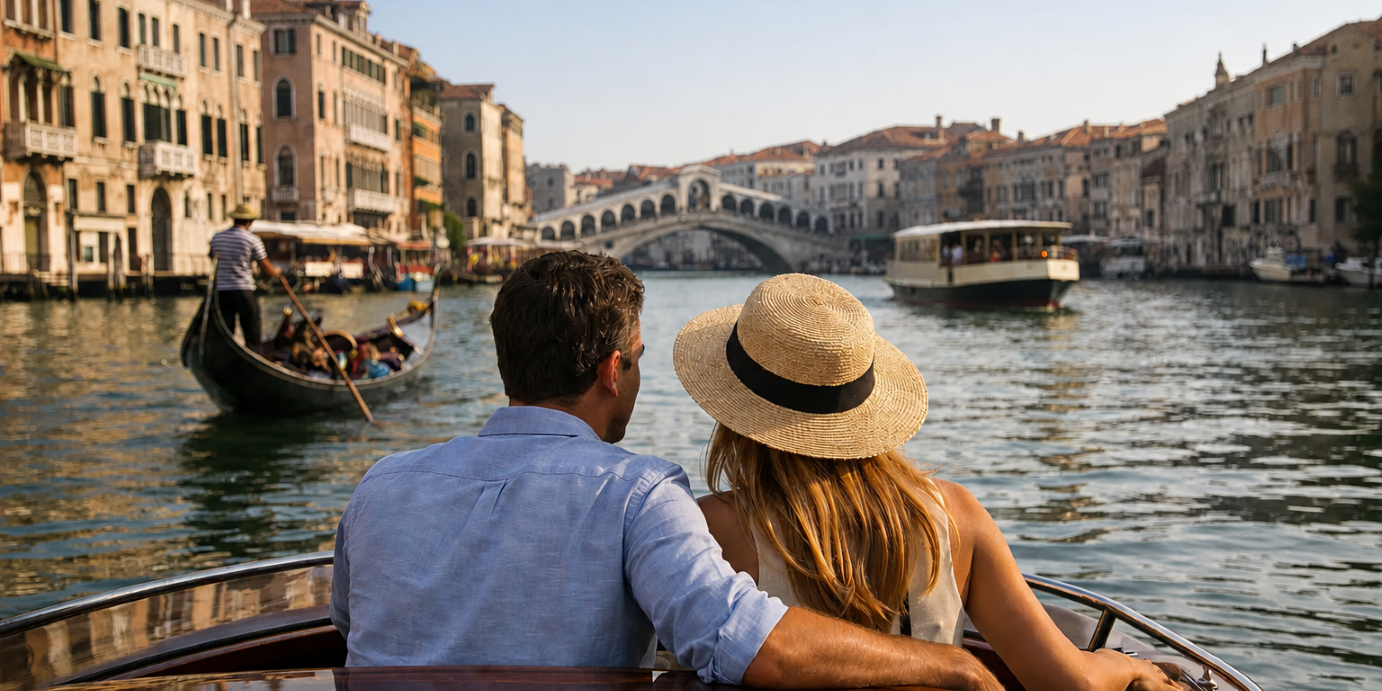
Venice rewards travelers who slow their pace. The city is not built around roads, taxis, or hurried point-to-point journeys. It is built around narrow calli, quiet canals, small bridges, and unexpected squares where the most memorable moments tend to happen between plans. Knowing how to get around Venice means understanding when to walk, when to travel by water, and when a little extra comfort is worth arranging.
From a central San Marco address, many of the city’s defining sights are within an elegant walk. For farther neighborhoods, the vaporetto – Venice’s public water bus – is the practical answer. Add a private water taxi for a particularly graceful arrival or departure, and the city becomes remarkably easy to enjoy.
How to Get Around Venice: Start With the Right Mindset
Venice is entirely pedestrian in its historic center. Cars, rental vehicles, and conventional taxis stop at Piazzale Roma, the city’s road terminal, or on the mainland. From there, travel continues on foot or by boat. This can feel unfamiliar on arrival, especially with luggage, but it is also what preserves Venice’s extraordinary atmosphere.
Do not judge distances here by the map alone. A destination that appears close may involve several bridges, while a longer water route can be more relaxing than a 20-minute walk through busy lanes. In general, walking is best for exploring nearby districts at an unhurried pace, while boats are ideal for crossing the Grand Canal, reaching the train station, visiting the islands, or returning home after a full day.
The key is to leave a little room in the schedule. Venice has a way of replacing the shortest route with a beautiful detour, and that is often part of the pleasure.
Walking: The Most Intimate Way to See Venice
Walking is the finest way to experience the city as a resident rather than simply moving through it. From San Marco, you can comfortably reach the Rialto area, the Accademia, Campo Santo Stefano, La Fenice, and many excellent galleries, cafés, and artisan shops without boarding a boat.
The city’s directional signs are useful, particularly those pointing toward San Marco, Rialto, Ferrovia for the train station, and Piazzale Roma. Still, Venice’s lanes can be deliberately disorienting. A mapping app is helpful, but it may not always account for temporary bridge closures, high water, or the reality that an entrance faces a canal rather than a street.
A simple approach works best: use major landmarks to orient yourself, then allow yourself to wander within a neighborhood. Keep the Grand Canal, St. Mark’s Square, or the Accademia Bridge in mind as reference points. If you arrive at a quiet campo with no obvious route forward, you are rarely truly lost. You are usually only a few minutes from a familiar sign or a vaporetto stop.
Comfortable shoes matter more than formal footwear. Venetian paving can be uneven, bridges have steps, and even a short stroll often becomes longer once a beautiful storefront or secluded church catches your attention. For evenings out, it is wise to allow extra time rather than rushing across the city.
Crossing Bridges With Luggage
Bridges are one reason a central stay can make such a difference. Wheeled luggage must be lifted over steps repeatedly, and a route that is simple with a small bag can become tiring with larger cases. If you are arriving with substantial luggage, consider a private water taxi that can bring you close to your accommodation, subject to the nearest accessible landing point.
For a lighter arrival, a public boat service can be an excellent choice. The best option depends on your arrival point, the time of day, the amount of luggage you have, and how much you value a direct, private transfer.
The Vaporetto: Venice’s Essential Public Transport
The vaporetto is the city’s public water bus network and one of the pleasures of staying in Venice. These boats travel along the Grand Canal and connect the major districts with the lagoon islands. Think of them as a combination of subway, bus, and scenic cruise, though they are very much part of daily Venetian life.
For guests based near San Marco, vaporetto stops make it easy to reach Santa Lucia train station, Piazzale Roma, Cannaregio, Dorsoduro, and the islands. The Line 1 route travels slowly along the Grand Canal, stopping frequently and offering wonderful views of palaces. It is ideal when you have time to look up. Line 2 is generally faster on key stretches and can be more convenient when you are heading to a reservation or catching a train.
Tickets are available as single rides or timed travel passes. A pass can offer good value if you expect to use boats several times daily, especially when including island excursions. If your plans focus on San Marco, Rialto, and Dorsoduro, you may walk more than you ride, making individual tickets more sensible. Always validate a paper ticket before boarding, and keep it available for inspection.
At busy times, board calmly and allow passengers to disembark first. Outdoor seating is lovely when available, but indoor space can be more comfortable in cool weather or during a crowded commute. Keep bags close, particularly when moving on and off the boat.
Choosing Between Line 1 and Line 2
Choose Line 1 when the journey itself is part of the day. Its slow passage along the Grand Canal is especially beautiful in the early morning, at sunset, or after dinner, when illuminated palazzi reflect on the water.
Choose Line 2 when time is more valuable than views. It is often the better option for getting between San Marco, Rialto, and the transportation hubs efficiently. Routes and schedules can change seasonally or during events, so checking the current timetable before an important journey is sensible.
Water Taxis: The Most Comfortable Arrival
A private water taxi is not the everyday choice, but it is one of Venice’s most distinctive experiences. From Marco Polo Airport, Piazzale Roma, or Santa Lucia station, a water taxi can provide a direct and polished introduction to the city, gliding through the lagoon and into the smaller canals near your destination.
This is particularly appealing after a long flight, when traveling with luggage, or when celebrating a special occasion. It offers privacy, assistance with bags, and the pleasure of seeing Venice emerge from the water rather than from a crowded terminal. The trade-off is cost: private water taxis are significantly more expensive than public transport, so they are best viewed as a comfort-led choice rather than a necessity.
For travelers arriving at Marco Polo Airport, shared airport boat services offer a middle ground. They cost less than a private taxi and deliver passengers to selected stops around Venice, though they make multiple stops and can take longer. A private transfer is the more efficient option when timing and ease are priorities.
Arriving by Plane, Train, or Car
Marco Polo Airport is connected to Venice by land bus, shared boat service, and private water taxi. A land transfer to Piazzale Roma is usually the quickest budget-conscious route, after which you can continue by vaporetto or walk if your accommodation is nearby. The airport boat is more atmospheric, while a private taxi is the most direct and comfortable.
Santa Lucia train station sits directly on the Grand Canal, making onward travel straightforward. Vaporetto stops are immediately outside, and a private taxi can be arranged from the station waterfront. If you are staying in the central districts and carrying only manageable bags, walking may be possible, but it is worth considering the bridges along the route.
If arriving by car, plan to park at Piazzale Roma or on Tronchetto before entering the historic city. Do not rely on driving navigation once you reach Venice. Your car will remain outside the pedestrian island for the duration of your stay, which is precisely as it should be.
Gondolas, Traghettos, and the Islands
A gondola ride is a Venetian ritual, but it is best treated as an experience rather than transportation. It is a wonderful way to see smaller canals from a different perspective, especially in quieter areas away from the busiest routes. Agree on the duration and price before departure, and choose an evening ride if you prefer a more intimate atmosphere.
For a brief and practical crossing of the Grand Canal, look for a traghetto. These simple gondola ferries operate at a few traditional crossing points where no nearby bridge exists. They are quick, inexpensive, and charmingly local.
The vaporetto also makes day trips to Murano, Burano, Torcello, and the Lido easy to arrange. Murano is known for glassmaking, Burano for its colorful houses and lace heritage, Torcello for its quiet, historic character, and the Lido for its open beaches and relaxed pace. Allow more time than the timetable suggests, particularly in high season, and avoid trying to see every island in one day.
A Few Details That Make Venice Easier
Venice works best when each day has one anchor: a museum reservation, a lunch in a particular district, an evening concert, or a boat departure. Build the rest around it. Cross the city on foot in the morning, take a vaporetto when your feet need a rest, and leave enough time to return before dinner without watching the clock.
During acqua alta, seasonal high water, raised walkways may appear in low-lying areas. Waterproof shoes or overshoes can be useful, and public boats may be busier than usual. In summer, travel early or later in the day when the lanes are cooler and the light is softer. After dark, Venice is generally magical for walking, but use well-lit main routes if you are unfamiliar with a neighborhood.
The most satisfying way to move through Venice is not to treat it as a puzzle to solve. Walk with curiosity, use the water when it adds comfort or saves time, and let the city reveal itself at the pace it was made for.