

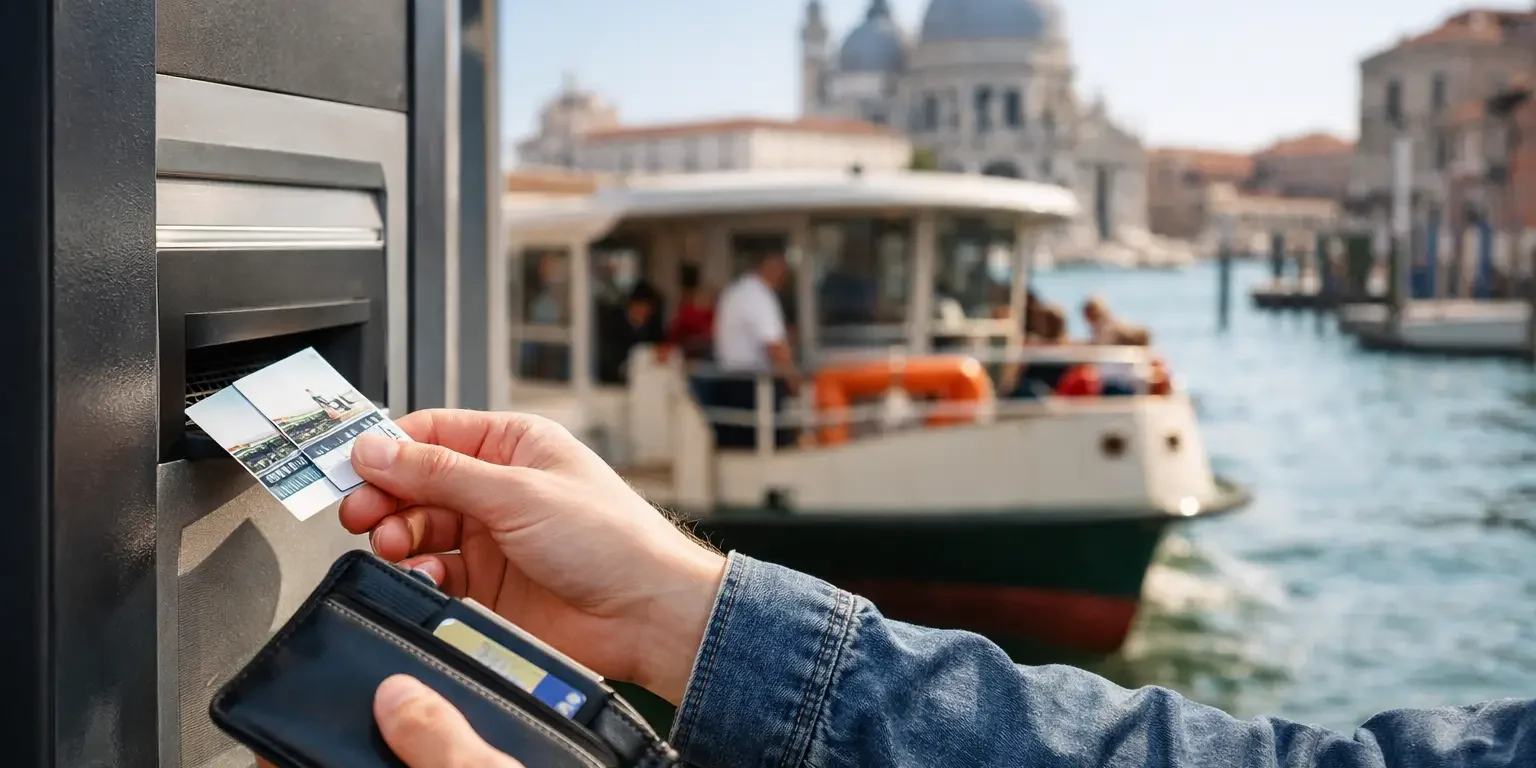
Venice begins at the water’s edge. Whether you arrive by train, car, or plane, knowing how to buy public transport tickets in Venice means you can move from arrival to aperitivo without spending precious time deciphering a ticket machine. A little preparation is especially worthwhile in a city where a vaporetto ride can be as memorable as the destination itself.
For guests staying near San Marco, much of the historic center is best enjoyed on foot. Public transport becomes most useful for arriving with luggage, reaching the islands, crossing the Grand Canal efficiently, or returning home after an evening in Cannaregio, Dorsoduro, or Giudecca.
Understand Venice’s public transport network
Venice’s principal public network is operated by ACTV. Its most recognizable service is the vaporetto, the public water bus that travels along the Grand Canal, around the city, and out to islands including Murano, Burano, Torcello, and Lido. ACTV also operates buses and trams on the mainland, as well as the People Mover connecting Piazzale Roma with Tronchetto and the cruise terminal area.
For most visitors, the decision is simple: buy individual water-bus tickets if you expect to make only one or two journeys, or choose a time-based travel pass if you will use vaporetti repeatedly. The passes are available for different durations and can offer much better value when island visits and several water crossings are part of the itinerary.
There is one important distinction to keep in mind. Airport water transfers, such as Alilaguna services from Marco Polo Airport, are generally separate from the standard ACTV pass. The same can apply to some airport bus services. Always confirm that your chosen ticket covers the route you intend to take before boarding.
How to buy public transport tickets in Venice before arrival
The most comfortable approach is to arrange tickets before you travel. Venice’s official public transport sales system allows visitors to purchase many tickets and passes online in advance. Depending on the product selected, you may receive a digital confirmation, a booking code to collect a physical ticket, or instructions for activation.
Buying ahead is particularly helpful after a long flight or train journey, when the priority is reaching your apartment rather than joining a line at Piazzale Roma or the airport. Keep your confirmation available on your phone and, if possible, save a screenshot as well. Mobile signal is usually reliable, but it is never wise to depend on it at the exact moment a ticket inspector requests proof of travel.
If you prefer to decide once you arrive, physical tickets are widely available. Look for ACTV ticket offices and authorized resellers at Marco Polo Airport, Santa Lucia train station, Piazzale Roma, major vaporetto stops, and some tobacconists and newsstands. Ticket machines at the busiest points typically offer an English-language option and accept major cards, although having a second payment method is sensible.
Buying at a ticket machine
Ticket machines are practical, but they can feel less inviting when a queue forms behind you. Select English, then choose between a single ticket, a time-based pass, or an airport-related option. Check the number of travelers and dates carefully before paying.
Once the ticket is issued, store it somewhere dry and easy to reach. Venice is a water city, and paper tickets do not appreciate an unprotected pocket on a rainy day or a hurried boarding at a crowded dock.
Using an app or digital ticket
Official transport apps and mobile ticket options can be convenient for travelers who prefer not to carry paper. They are best used when you have confirmed how the ticket must be activated and displayed. Some products require activation before the first journey, while others may need to be converted into a physical pass at a collection point.
Do not assume that a payment receipt is a valid ticket. A valid digital ticket should clearly show the active product, relevant dates or duration, and any required QR code or verification method.
Choose the ticket that suits your itinerary
An individual ACTV ticket is often the right choice for a straightforward ride, such as traveling from Santa Lucia station to the San Marco area with lighter luggage, or taking a single evening crossing of the Grand Canal. It is less attractive if your plans include multiple rides in one day, because Venice’s water buses are designed for frequent movement rather than inexpensive one-off sightseeing.
A time-based pass is usually the more elegant option when you want freedom to follow the day as it unfolds. It suits a morning in Murano, a lunch in Burano, a sunset ride along the Grand Canal, and perhaps a return from Lido without calculating every journey. These passes typically run for a defined number of consecutive hours rather than calendar days, but the exact terms can change, so review the current conditions at the time of purchase.
Consider an airport transfer separately. From Marco Polo Airport, travelers commonly choose a private water taxi, a shared airport water service, or a bus connection to Piazzale Roma followed by a vaporetto or walk. The private water taxi is the most direct and atmospheric arrival for those who value privacy and door-to-door ease. Public options are more economical, but they involve more stops, more passengers, and occasionally a short walk with luggage at the final stage.
Validate your ticket before boarding
Validation is the step visitors most often overlook. With a paper ACTV ticket or travel pass, use the electronic validator at the vaporetto stop before boarding. Hold the ticket against the reader until you see or hear confirmation. The same principle applies when using buses or trams.
A ticket that has not been activated is not valid simply because it has been purchased. Ticket inspections are routine, and fines for an unvalidated or incorrect ticket can be substantial. Validate only when you are ready to begin using the ticket, especially if you have purchased a pass whose duration starts at the first activation.
At busy stops, validate before the boat arrives rather than trying to do so while the boarding area fills. Keep the ticket accessible throughout the journey, not tucked into luggage. This small habit makes moving through Venice feel far more composed.
Make the most of the vaporetto experience
The vaporetto is public transport first, but it is also one of Venice’s most beautiful ways to see the city. Line 1, which travels slowly along the Grand Canal, is ideal when you have time to watch palazzi, churches, and daily Venetian life unfold from the water. Faster routes can be better when you are simply trying to reach a restaurant reservation or an island departure.
For a quieter ride, avoid the busiest commuting windows when possible and board a few stops before the most popular points. If you are carrying larger bags, stay clear of narrow boarding areas and allow other passengers to disembark first. Venetian water travel has its own rhythm: unhurried in appearance, yet surprisingly efficient when everyone gives one another space.
It is also worth remembering that walking is often faster within the central neighborhoods. A map may suggest a water route, but a ten-minute stroll through the lanes can be the lovelier choice. Save your pass for journeys where the water genuinely adds convenience: crossing to Giudecca, reaching the islands, traveling from the station, or enjoying a final evening ride.
A few practical details for a polished stay
Check the name of your nearest vaporetto stop before you set out, particularly if you are arriving after dark. Venice has many small calli and bridges, and even a centrally located residence can be reached by several different routes. A short walk over bridges may be preferable to a closer stop that requires navigating a busy route with suitcases.
Water levels, maintenance work, weather, and special events can occasionally affect service. If you have a timed museum entry, dinner reservation, or airport departure, allow a comfortable margin rather than relying on the last possible boat. Personalized local guidance can make these choices easier; at Ca’ Sant’Angelo, thoughtful guest support helps turn practical questions into an untroubled part of the stay.
Above all, buy the ticket that gives your itinerary room to breathe. Venice rewards the traveler who can pause for a quiet campo, accept an unplanned detour, and take the water home when the lights begin to shimmer across the lagoon.