

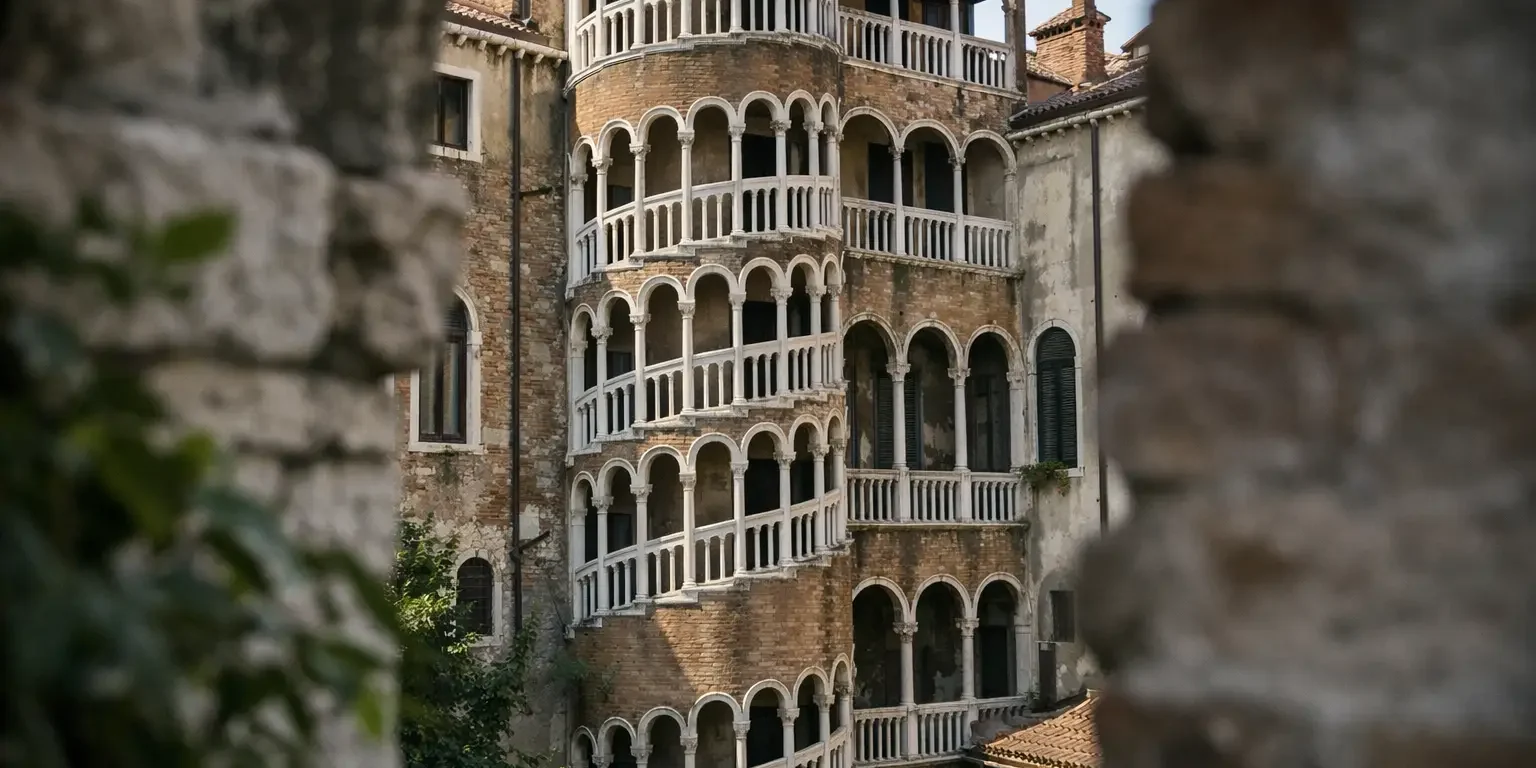
A few turns from the familiar movement of St. Mark’s Square, a small courtyard reveals one of Venice’s most arresting architectural surprises. The scala contarini del bovolo rises in pale stone, its open spiral winding upward around a cylindrical tower with the quiet confidence of a place that does not need to announce itself. For travelers who value Venice beyond its headline sights, it offers a memorable pause: intimate in scale, richly detailed, and remarkably close to San Marco.
A staircase with a distinctly Venetian character
The word bovolo means “snail” in Venetian dialect, an apt description for the staircase’s elegant corkscrew form. Built at the end of the 15th century for the noble Contarini family, the tower transformed what began as a palazzo stairway into a statement of taste and status. Its architecture belongs to Venice, yet it also reflects the city’s long conversation with the wider world.
Gothic pointed arches, Renaissance symmetry, and delicate Istrian stone appear together in its layered façade. On each level, a sequence of arcades wraps the staircase, creating changing patterns of light and shadow as visitors climb. Rather than the grand, ceremonial scale of the Doge’s Palace, this is a more personal kind of splendor – an architectural flourish hidden within the everyday fabric of the city.
That contrast is part of its appeal. Venice can be overwhelming when approached only through its largest monuments. Scala Contarini del Bovolo rewards a slower pace and an eye for the details found just beyond the main route.
Finding Scala Contarini del Bovolo near San Marco
The staircase stands in the San Marco district, tucked behind the commercial streets that connect St. Mark’s Square and the Rialto area. It is close enough to include naturally in a day of central Venice, but sufficiently concealed that the final approach still feels like a small discovery.
The most enjoyable way to arrive is not necessarily the quickest one. Leave room to follow the narrower calli, notice the worn thresholds and quiet courtyards, and allow Venice’s changing sounds to guide the walk. Maps are useful, particularly on a first visit, but this is also a corner of the city where looking up and slowing down improves the experience.
Its central position makes it especially convenient for guests staying near San Marco. From an elegant residential base such as Ca’ Sant’Angelo, it can be a graceful morning destination before the city’s busiest landmarks call, or a late-afternoon interlude between a museum visit and dinner.
The climb and the view from the belvedere
The experience is defined by the ascent. The stairway is not especially long by modern standards, but its enclosed spiral and uneven historic character ask visitors to take their time. This is not a visit to rush, particularly for anyone uncomfortable with narrow stairs or heights.
As the climb progresses, the city appears through the arches in carefully framed glimpses: rooflines, chimney pots, bell towers, and the distant shimmer of the lagoon. Each landing offers a slightly altered perspective. The pleasure lies as much in these partial views as in the final panorama.
At the top, the belvedere provides an unusual, elevated reading of Venice. You can see the dense geometry of the city, where tiled roofs sit close together and campanili punctuate the horizon. St. Mark’s Campanile is often the most immediately recognizable landmark, but the view feels less formal than the panorama from a major tower. It is a chance to see Venice at rooftop level, shaped by private terraces, small gardens, and the narrow passages between palazzi.
Photography is rewarding here, although the light matters. Early morning tends to bring softer tones and a quieter atmosphere. Later in the day, warmer light can give the stone and rooftops greater depth. On bright summer afternoons, the interior spiral may feel more dramatic than the view itself, with sunlight cutting through the arcades.
How to plan a comfortable visit
Scala Contarini del Bovolo is a ticketed attraction, and opening times, entry procedures, and access arrangements can vary by season, special events, and conservation needs. Confirm the current details before setting out, rather than building a tightly timed itinerary around an assumed schedule.
A visit generally suits a brief but unhurried stop. Allow time not only for the climb and the view, but also for the small courtyard and for the pleasure of arriving through the surrounding lanes. It pairs well with a morning visit to St. Mark’s Basilica, the Teatro La Fenice neighborhood, or the quieter streets toward Campo Manin.
Comfortable shoes are essential. Venice’s paving stones are beautiful but irregular, and the staircase itself is historic rather than designed for contemporary convenience. A light layer can also be useful outside the warmest months, as the open loggias catch the breeze.
For travelers with limited mobility, the staircase’s historic layout may present a real constraint. This is one of those Venetian experiences where authenticity and accessibility do not always align. It is worth considering in advance, so the day remains pleasurable rather than demanding.
What makes this hidden landmark worth your time
Venice has no shortage of extraordinary viewpoints, churches, and palaces. The reason to choose this one is not that it replaces the city’s celebrated landmarks. It offers a different emotional register.
The staircase gives form to an essential Venetian pleasure: finding beauty in a place that seems almost incidental. It sits behind an unassuming entrance, rises from a compact courtyard, and offers a view earned gradually rather than presented all at once. That sense of progression makes the visit feel personal.
It also reveals something meaningful about the city’s architecture. Venice was built with an acute awareness of spectacle, but spectacle often appears in compressed spaces. A façade may face a narrow canal. A frescoed hall may sit behind a plain doorway. Here, an elaborate tower emerges from a quiet courtyard, proving that even a practical element such as a staircase could become an expression of ambition and imagination.
For couples and independent-minded travelers, it can be a welcome counterpoint to a day of essential sights. The setting is photogenic, but it does not feel designed only for photographs. It invites observation: the texture of the stone, the rhythm of the arches, the distant sounds that drift upward from the streets below.
Pairing the visit with a more relaxed Venice day
The most satisfying Venice itineraries balance landmark moments with time that is left open. After visiting Scala Contarini del Bovolo, resist the urge to immediately check off the next major attraction. Pause for coffee in a nearby campo, browse a small artisan shop, or take a less direct route back toward the Grand Canal.
If your schedule is short, the staircase works beautifully as part of a compact San Marco morning. Visit early, then continue toward St. Mark’s Square before the midday crowds become more pronounced. If your schedule allows greater freedom, make it a late-afternoon destination and let the changing light set the pace for an evening in the district.
There is a practical advantage to staying centrally in Venice: the city becomes less about managing transport and more about choosing a direction. Returning to your apartment for a rest, changing before dinner, or simply enjoying a quiet moment between outings can transform the rhythm of a stay. The hidden corners of Venice are most rewarding when there is no need to hurry through them.
Scala Contarini del Bovolo is not a grand attraction in the conventional sense. It is better than that for the right traveler: a beautiful detour, a glimpse into Venetian private life, and a reminder to look beyond the obvious doorway. Leave a little space in your plans for such moments. Venice often reveals its finest details when the day is allowed to unfold at its own pace.