

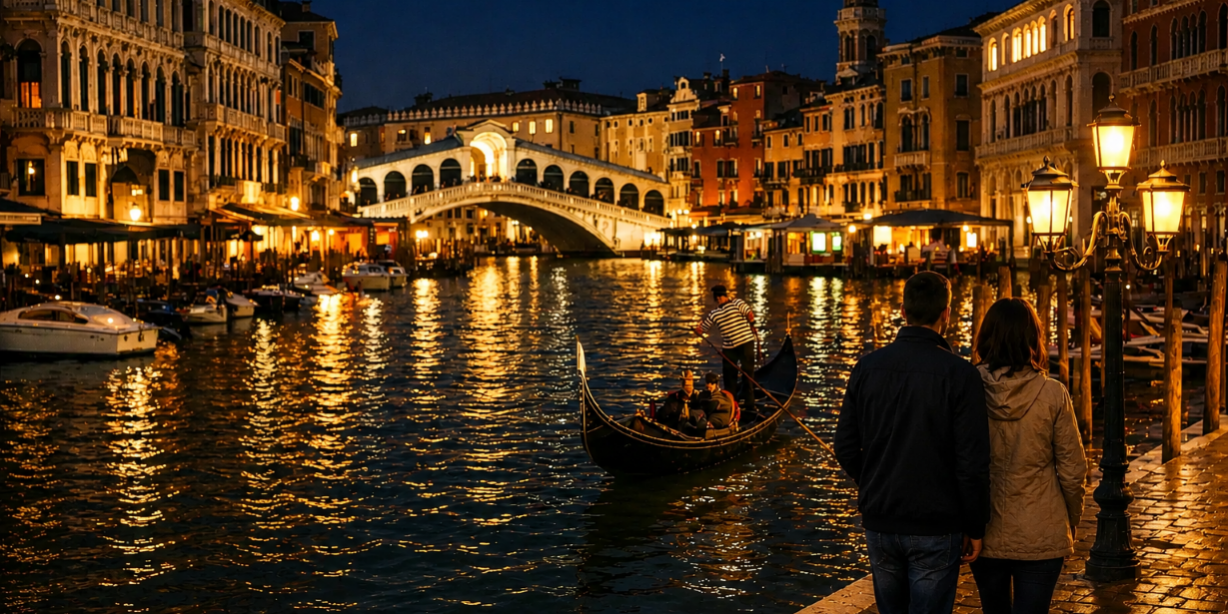
The first time Venice goes quiet at night, it can feel almost theatrical. Day crowds fade, footsteps echo over stone bridges, and narrow calli seem more mysterious than they did at noon. That atmosphere leads many travelers to ask the same practical question: is Venice safe at night?
For most visitors, the answer is yes. Venice is generally considered one of the safer cities in Italy to walk after dark, especially in central areas such as San Marco, San Polo, Dorsoduro, and Cannaregio. Violent crime is uncommon, and the city’s layout, with its steady residential presence and pedestrian streets, often feels calmer than larger urban destinations. Still, safe does not mean carefree. As in any popular European city, a confident evening in Venice comes down to knowing what is normal, what deserves caution, and how to move through the city comfortably.
Is Venice safe at night in the main tourist areas?
In the neighborhoods most travelers visit, Venice is usually quite safe after dark. Around San Marco, the streets remain active into the evening, particularly near major hotels, restaurants, and the routes connecting key landmarks. Even when the crowds thin, there is often enough movement to avoid the sense of total isolation.
That said, Venice changes character at night. A short walk can take you from a lively campo into a very quiet lane in less than a minute. This is part of the city’s charm, but it can also feel disorienting if you are unfamiliar with the layout. Visitors sometimes mistake that silence for danger when it is often simply Venice returning to its residential rhythm.
Dorsoduro tends to feel relaxed and elegant in the evening, especially near well-known cultural areas and along the canals. Cannaregio can be lively in places and peaceful in others, with a more local feeling once you move away from the busiest restaurant strips. San Polo and Santa Croce are generally manageable as well, though the smaller streets can feel empty late at night. Near Piazzale Roma and the train station, it is wise to stay a little more alert, not because Venice becomes unsafe in a dramatic sense, but because transport hubs in any city tend to attract more opportunistic behavior.
What are the real risks at night?
The biggest concern for most travelers in Venice is not violent crime. It is petty theft, distraction, and simple disorientation.
Pickpocketing is more common during the day in crowded areas, but it can still happen in the evening around busy vaporetto stops, major squares, or during events. A phone left on a café table or a wallet placed in an open coat pocket is a greater risk than walking itself. Venice rewards a polished, relaxed style of travel, but not a careless one.
Getting lost is another very real nighttime issue. Venice’s beauty is tied to its maze-like plan, and digital maps are not always perfect in narrow passageways. At night, when fewer shops are open and fewer people are out, a wrong turn can leave you standing in a silent courtyard wondering whether you are still heading in the right direction. This is more unsettling than dangerous, but it can shake your confidence quickly.
There are also practical physical hazards. Bridges have steps, some lanes are uneven, and certain canal edges feel less forgiving when the light is low or the pavement is damp. If you have been enjoying a long dinner or an evening aperitivo, extra care is sensible.
Why Venice often feels safer than other cities
Venice has a few qualities that work in the visitor’s favor. One is the absence of cars. Without traffic, there is less noise, less chaos, and fewer of the risks that can make nighttime movement stressful elsewhere. The city is also compact in its central areas, so many evening outings involve walking rather than navigating unfamiliar transit systems.
Another factor is that Venice remains a lived-in city. Beyond the famous facades, there are residents returning home, waiters closing restaurants, hotel staff assisting guests, and water taxis moving across the canals. Even when a street is quiet, the city rarely feels abandoned in the way that some heavily commercial districts can after business hours.
High-end travelers often notice something else as well: where you stay makes a significant difference to how secure Venice feels. A refined, central location with a smooth arrival, clear directions, and responsive guest support removes much of the uncertainty that can make nighttime movement stressful. In an area like San Marco, for example, being close to major sights while tucked into a more residential setting offers both convenience and reassurance.
Tips for moving around Venice confidently after dark
If you are wondering whether Venice is safe at night for walking, the most useful answer is yes, especially if you approach the evening with a little foresight.
Start with your route. Before dinner or an event, take a moment to note the nearest landmark, vaporetto stop, and a simple walking path back to your apartment or hotel. Screenshot directions in case your signal weakens, and pay attention to the names of larger squares and churches, which are often easier to follow than tiny side streets.
Keep your belongings secure but unobtrusive. A crossbody bag worn close to the body is more elegant and more practical than carrying shopping bags, loose wallets, or a phone in an open pocket. Venice is best enjoyed with your attention on the city, not on constantly checking whether something has gone missing.
Choose well-lit routes when possible, especially if it is your first evening. In Venice, the shortest path is not always the most comfortable one. A route that passes through a larger campo or along a more active street may feel far better than a shortcut through empty lanes.
If you are returning late, consider a water taxi when appropriate. It is not always necessary, but it can be an excellent option after a special evening out, on arrival night, or when traveling with luggage. A graceful arrival is not just luxurious in Venice. It can also be reassuring.
Is Venice safe at night for couples and first-time visitors?
For couples, Venice can feel especially pleasant at night. Evening walks are one of the city’s great pleasures, and central districts are generally well suited to them. The atmosphere is romantic, but it is also practical – there is enough activity around key areas to avoid feeling isolated, while the absence of road traffic makes walking more relaxed.
For first-time visitors, the challenge is usually confidence rather than safety. Venice does not operate on the visual logic of a grid. You may find yourself crossing several bridges, turning into a lane that narrows unexpectedly, then emerging into a bright square full of conversation. This rhythm can be charming once you settle into it, but on the first night it can feel unfamiliar.
That is why accommodation matters. Staying in a well-positioned residence with attentive guest care can transform your experience of the city after dark. A beautifully restored apartment in a central quarter does more than provide comfort. It gives you a reliable base, a neighborhood you begin to recognize, and the freedom to enjoy Venice in a more local, unhurried way.
When should you be more cautious?
Venice is not a city that typically calls for alarm, but there are moments when a little extra awareness is wise. Late at night around transport points, during very crowded festival periods, or after heavy rain when surfaces are slippery, it pays to move more deliberately.
Solo travelers should take the same precautions they would in any city: avoid displaying valuables, be careful with alcohol, and trust instinct if a street feels too isolated for comfort. If a route seems unclear, stepping back toward a busier area is often the best choice. In Venice, there is nearly always another way.
It is also smart not to assume every quiet area is the right one. Venice has many dead ends that lead directly to canal edges or private courtyards. If your map seems confused, pause in a more open, lit area rather than continuing deeper into an empty lane.
A more accurate answer than yes or no
So, is Venice safe at night? In most cases, yes – and more so than many travelers expect. The city’s risks are usually manageable, practical ones rather than dramatic threats. The trade-off is that Venice asks a bit more from you in return: awareness of your surroundings, a little respect for its unusual layout, and the good judgment to choose comfort as well as charm.
That balance is part of what makes an evening here so memorable. Venice at night is not about rushing from one attraction to the next. It is about feeling at ease in the city’s quieter hours, crossing a lantern-lit bridge, hearing water move in the dark, and knowing you can enjoy that beauty with confidence when you are well prepared.