

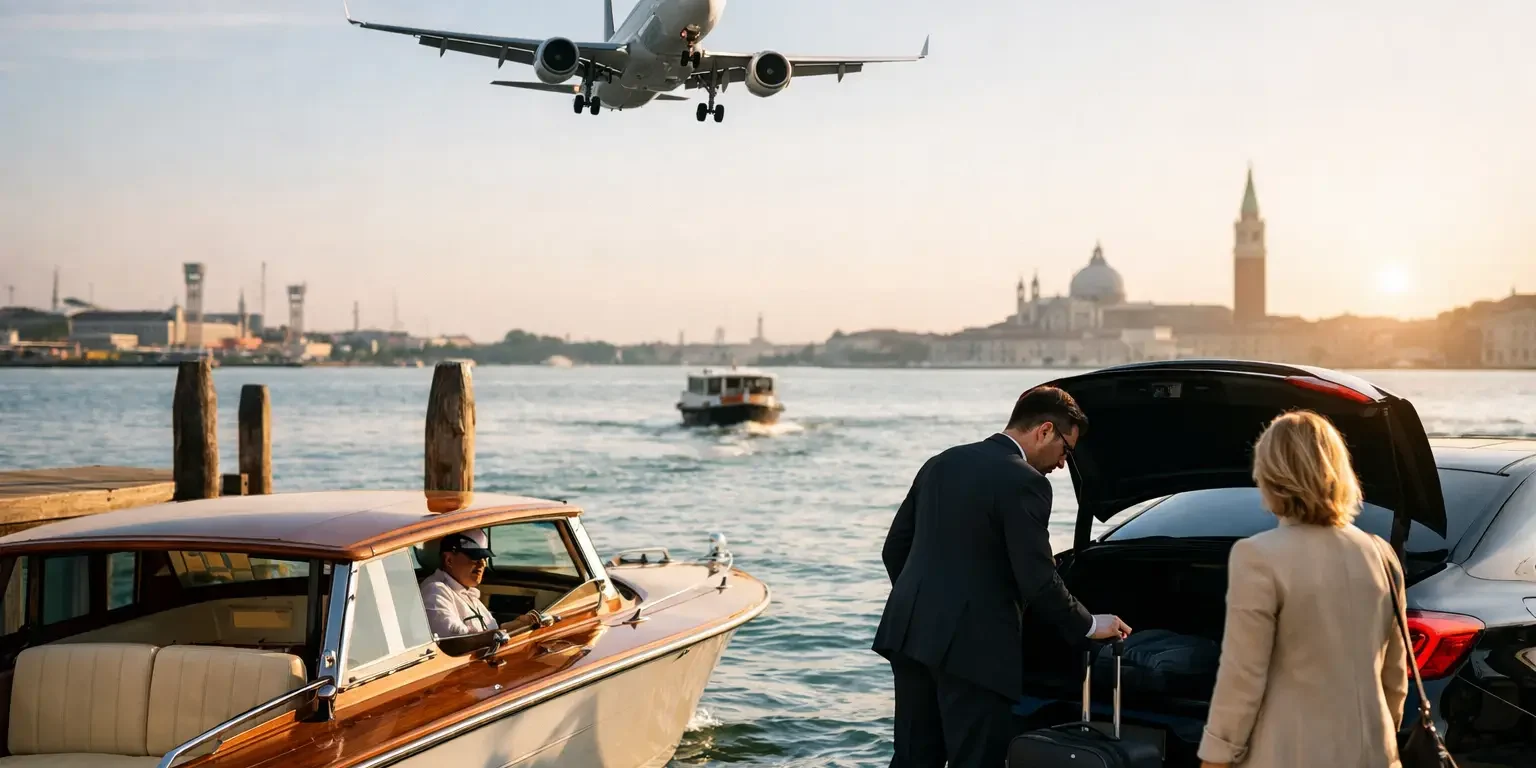
Landing in Venice is the moment many travelers realize this city asks you to move differently. There are no taxis waiting outside to carry you down broad avenues, and there is no simple hotel shuttle culture to rely on. A thoughtful Venice airport transfer guide makes all the difference, especially if you value comfort, privacy, and a smooth arrival into San Marco.
For guests staying in the historic center, the right transfer is not only about cost. It is about how you want to begin your time in Venice. Some travelers prefer the polished ease of a private water taxi. Others are happy to trade a little convenience for a more economical route by shuttle boat, bus, or train. The best choice depends on your arrival time, luggage, budget, and how much energy you want to spend managing connections after a flight.
Venice airport transfer guide: start with the right airport
Venice is primarily served by Marco Polo Airport, which is the closest and most convenient airport for reaching the city center. Some visitors also arrive through Treviso Airport, used by several low-cost carriers. The transfer experience is quite different depending on which airport you land at, so it is worth confirming this before you plan anything else.
If you are flying into Marco Polo, you can reach Venice by private water taxi, Alilaguna public boat, or a land transfer to Piazzale Roma followed by a vaporetto or walk. If you are arriving at Treviso, the route is simpler but less romantic at first – you will generally travel by bus or car to Venice, then continue into the historic center.
For most luxury travelers staying near San Marco, Marco Polo offers the most graceful arrival options.
The most comfortable choice: private water taxi
If your priority is ease, a private water taxi is the finest way to enter Venice. After your flight, you are met at the airport and escorted toward the dock, where a sleek motor launch takes you across the lagoon and into the canals. It is efficient, private, and distinctly Venetian.
This option is especially appealing after a long international journey. You avoid crowded queues, limit the number of transitions, and begin your stay with the city at its most memorable – water, light, and palazzo facades appearing one by one as you approach the center.
There are, however, trade-offs. Private water taxis are the most expensive airport transfer option by a comfortable margin. They can also be affected by weather, high traffic periods, or docking conditions near your final address. In Venice, “door-to-door” is not always literal. Depending on the tide and the exact location of your accommodation, you may still have a short walk over bridges or through narrow lanes.
For travelers with substantial luggage, evening arrivals, or a preference for a highly managed experience, the premium is often worth it.
A balanced option: Alilaguna water shuttle
The Alilaguna boat service sits in the middle ground between exclusivity and value. It departs from Marco Polo Airport and stops at several points across Venice, including areas convenient for San Marco.
This is a practical choice for visitors who want the pleasure of arriving by water without paying for a private launch. The views can be beautiful, and the route feels unmistakably Venetian. That said, it is a shared service, so you should expect waiting time, multiple stops, and less flexibility. If your flight arrives late, or if you are carrying several bags, the appeal can fade quickly.
It also helps to study the stop closest to your accommodation rather than assuming “San Marco” means a very short walk. In Venice, ten minutes on foot can feel longer when you are managing luggage over stone bridges.
The most economical route: bus to Piazzale Roma
For travelers focused on value, the bus from Marco Polo Airport to Piazzale Roma is usually the simplest low-cost option. From there, you continue by vaporetto, private water taxi, or on foot, depending on where you are staying.
This route works well if you are traveling light and arriving during the day. It is straightforward, frequent, and generally faster than many first-time visitors expect. But it is not the most relaxing way to begin a premium city break. Once you reach Piazzale Roma, you are still at the edge of Venice and must manage the second part of the journey yourself.
That second stage is where the real effort begins. Vaporetto stops can be busy, lines are not always obvious to newcomers, and carrying luggage through a crowded boat after a flight is rarely elegant.
Train connections if you are arriving from elsewhere in Italy
Not every airport transfer begins at the airport. Many guests land in another Italian city and continue to Venice by rail, or combine Venice with Florence, Milan, or Rome during a longer trip. In that case, you will arrive at Santa Lucia train station, directly on the Grand Canal.
From Santa Lucia, San Marco is reachable by vaporetto, private water taxi, or porter-assisted walking route if you are staying relatively close. The train is often the least stressful choice for intercity travel in Italy, but the final transfer inside Venice still deserves planning.
If your schedule allows, arranging a private onward transfer from Santa Lucia can preserve the sense of ease that luxury travel should offer.
Venice airport transfer guide for San Marco stays
San Marco is one of the most desired areas in Venice for good reason. It places you within easy reach of major landmarks, elegant cafés, and the city’s most atmospheric streets, while still allowing moments of quiet away from the busiest thoroughfares.
Yet location also shapes your transfer decision. A stay in San Marco is best served by a route that minimizes unnecessary walking with luggage. Private water taxi is often the most comfortable fit, particularly for first-time visitors or anyone arriving after an overnight flight. Alilaguna can work well too, provided the nearest stop is convenient and you are comfortable with a shared service.
Bus and vaporetto combinations are absolutely workable, but they ask more of you. If you love efficiency and do not mind a little logistics, they can be entirely reasonable. If you want your arrival to feel polished from the first moment, a direct water transfer is usually the better answer.
For guests staying at Ca’ Sant’Angelo, the appeal of a carefully planned arrival is obvious. When your accommodations combine the privacy of a refined apartment with the service standards of a luxury stay, it makes sense for the journey in to match that standard.
What to consider before you book
The best transfer is rarely the same for every traveler. A few details matter more than people expect.
Arrival time changes everything. A midday arrival gives you more flexibility with shared boats and public transport. A late evening landing makes private arrangements far more appealing, especially if you are unfamiliar with Venice.
Luggage is another deciding factor. One carry-on and a weekend bag are easy enough to manage. Several larger suitcases can turn a “simple” public route into an exhausting one.
Budget matters, of course, but so does the value of your time and comfort. The least expensive option is not always the most sensible if it costs you an extra hour, multiple transfers, and a frustrating start to your stay.
Weather can also influence your choice. Venice is beautiful in rain, but less charming when you are standing outside waiting for a connection with wet luggage and an unclear route ahead.
Common mistakes to avoid
The most common mistake is underestimating the final walk. Venice looks compact on a map, but narrow lanes, bridges, and uneven paving make distances feel longer with bags in hand.
Another is assuming every water route is direct. Shared services can involve multiple stops and slower boarding processes, which may be perfectly acceptable in some cases and deeply inconvenient in others.
It is also wise not to leave everything until arrival day, especially in high season. Private transfers and even some shared services can become busy, and a little advance planning gives you better options.
Finally, be realistic about your travel style. Some visitors genuinely enjoy figuring things out as they go. Others would prefer to step off the plane knowing every detail is already arranged. Venice rewards self-sufficient travelers, but it is equally a city where thoughtful service can transform the experience.
Which transfer is best?
If you want the most elegant arrival, choose a private water taxi. If you want a good middle ground, Alilaguna offers a scenic and more moderate option. If keeping costs down is the priority, the bus to Piazzale Roma is dependable, followed by vaporetto or walking. If you are arriving from another Italian city, rail into Santa Lucia is often excellent, with a private final transfer worth considering.
The right choice is the one that suits the pace of trip you want to have. Venice has a way of rewarding good decisions early. Arrive calmly, arrive comfortably, and the city begins to open to you almost at once.
A beautiful stay in Venice should not begin with avoidable stress. Choose the transfer that lets you step into the city with your attention where it belongs – on the water, the light, and the rare pleasure of feeling expected.