

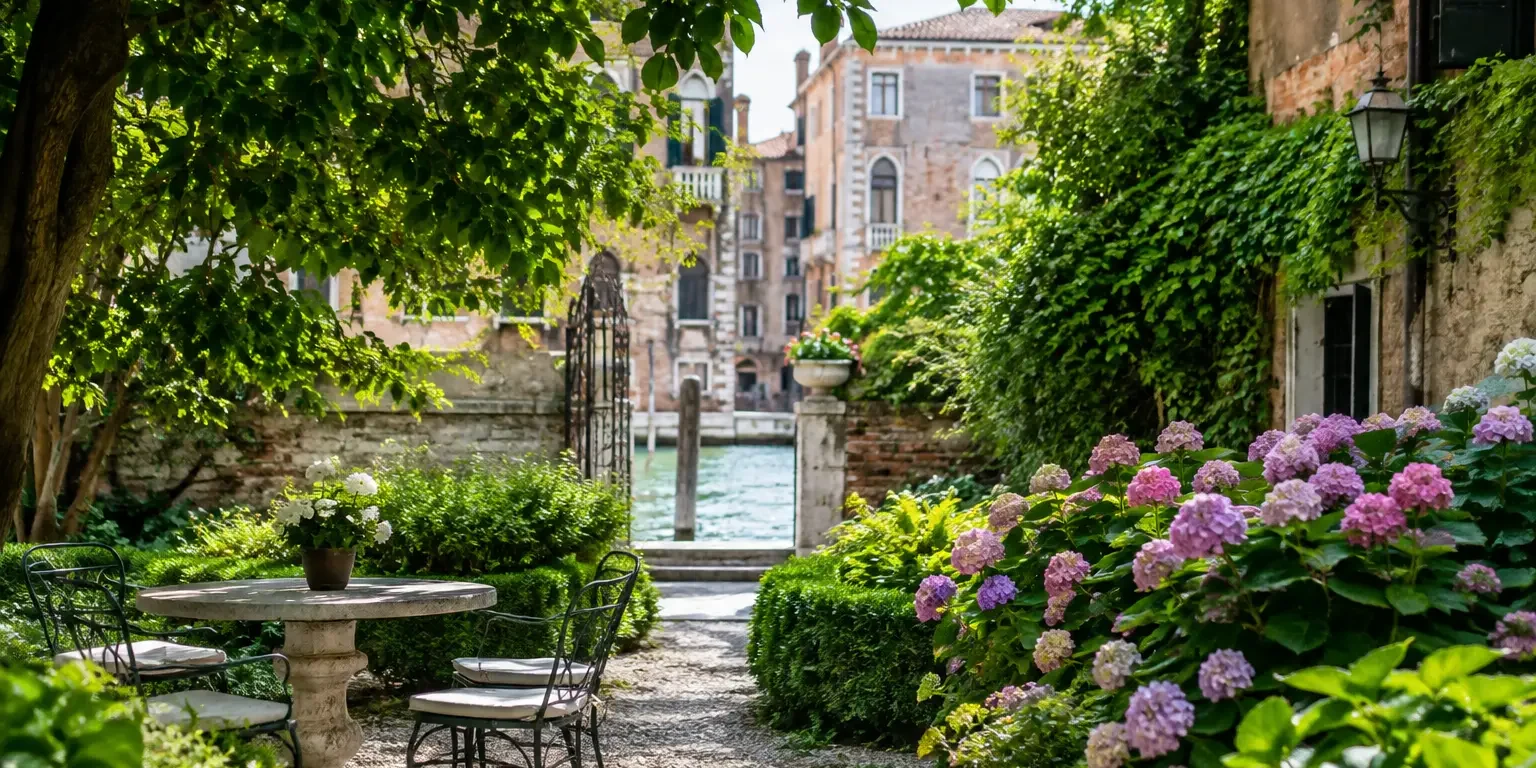
Before the first vaporetti fill the Grand Canal, Venice can feel unexpectedly green. A vine spills over a high brick wall, the crown of a magnolia appears beyond a locked gate, and birdsong travels across a silent courtyard. The private and secret gardens in Venice are not a checklist of attractions. They are a glimpse of the city as its residents have long known it: sheltered, cultivated, and wonderfully removed from the crowds.
For travelers who appreciate Venice at a more considered pace, these hidden spaces offer a different kind of luxury. Their appeal lies partly in their discretion. Many remain behind the façades of palaces, convents, and private homes, visible only in fragments from a bridge or a passing boat. Knowing what can be visited, what must simply be admired from afar, and how to approach both with respect makes the experience far more rewarding.
Why gardens feel so rare in Venice
Venice was built for water, trade, and dense urban life, not broad parks. Soil had to be brought in, freshwater managed carefully, and every planted square foot protected from salt air and lagoon winds. A garden was therefore both an accomplishment and a private refuge.
Behind many palazzi, especially those with generous plots along canals, noble Venetian families created formal gardens with clipped hedges, statues, wells, fruit trees, and shaded paths. Smaller courtyards might hold a single fig tree, roses, or pots of citrus. These spaces softened the city’s stone and water, while offering coolness and privacy during the warmer months.
That history explains why so many gardens remain concealed. They were never designed as public parks. Their walls were part of their purpose, protecting a domestic world that was deliberately separate from the busy streets and canals beyond.
Private and secret gardens in Venice: what visitors can see
The word secret can be misleading. Some gardens are genuinely private and cannot be entered without an invitation. Others are part of museums, cultural institutions, or seasonal programs, with access that changes according to events and conservation needs. The most satisfying approach is to balance a few dependable visits with the pleasure of noticing green spaces as you wander.
Giardini Reali, near St. Mark’s Square
The Royal Gardens are not private, but they are a graceful introduction to Venice’s quieter green side. Tucked beside St. Mark’s Square and the waterfront, they offer an elegant pause between the Basilica, the Doge’s Palace, and the Riva degli Schiavoni.
Their restoration has returned a sense of structure and calm to a historic garden that had long been overlooked. Expect paths, mature planting, water views, and welcome shade rather than the wildness of a hidden courtyard. For guests staying near San Marco, it is an especially easy place to begin a morning before the city’s principal sights become busy.
Palazzo Soranzo Cappello and its historic garden
In Cannaregio, Palazzo Soranzo Cappello is among the most evocative examples of a Venetian palace garden. Its grounds retain the atmospheric character visitors hope to find: aged walls, formal traces, and a feeling that the city has briefly stepped back in time.
Access is not something to assume. The palazzo is connected with cultural and institutional activity, so opening arrangements may vary. When visits or events are available, this is a place to approach as a historic site rather than a casual public garden. Confirm current access before building an itinerary around it.
Museum gardens and enclosed courtyards
Several Venetian museums and historic houses include small garden spaces or interior courtyards that provide a welcome change of pace. Ca’ Rezzonico, the museum of eighteenth-century Venice, is one of the most rewarding settings in which architecture, decorative arts, and garden atmosphere can be appreciated together.
These are not always gardens in the grand sense, and that is part of their charm. A stone wellhead, a few mature trees, and the sound of water against nearby foundations can reveal how Venetian domestic life once unfolded behind the grand public façades.
The gardens you may only glimpse
Some of Venice’s most memorable gardens are best encountered indirectly. Along the Grand Canal, through the quieter lanes of Dorsoduro, or on Giudecca, look beyond entrance portals and between buildings. A wrought-iron gate may reveal palms, oleanders, climbing wisteria, or a gravel path leading toward a palace entrance.
The island neighborhoods often offer the strongest sense of space. Giudecca has a more open character than central Venice, and its long waterfront edges have historically allowed room for gardens behind former convents and residences. Castello, particularly away from the main route to the Biennale, can also feel unexpectedly verdant, with planted courtyards and leafy residential corners.
There is a useful distinction to keep in mind: seeing a garden is not the same as having permission to enter it. In Venice, respecting that boundary is part of traveling well. Do not push through an open-looking gate, photograph into a private home, or treat a residential courtyard as an attraction. A passing glimpse is often exactly the experience the city offers.
How access to private gardens works
The occasional opportunity to enter a private garden usually comes through a cultural occasion, a scheduled guided visit, an exhibition, or a special opening connected with Venetian heritage. Availability can be limited, and plans may change with little notice. This is one of the few parts of a Venice itinerary where flexibility is preferable to expectation.
If a particular garden matters to you, ask your accommodation host or concierge before arrival. A well-connected local contact can advise whether a legitimate opening is scheduled during your stay and whether advance booking is required. They can also suggest alternatives if access is unavailable, saving valuable vacation time.
Private tours can sometimes provide entry to places not generally open to independent visitors, but discretion matters here as well. A higher price does not automatically mean meaningful access or a better experience. Look for a visit that clearly explains what is included, respects the property, and allows time to understand the garden’s history rather than simply using it as a backdrop.
Build a quieter day around the gardens
Gardens are most enjoyable when they shape the rhythm of a day rather than become another item to complete. Start early in San Marco with the Royal Gardens, then take a slower route toward Castello or Cannaregio. Allow time for a coffee, a waterside lunch, and unplanned turns down residential calli where greenery often appears without warning.
Afternoon light is particularly beautiful on brick walls and weathered garden gates, though midday heat can make shaded courtyards especially appealing from late spring through early fall. In cooler months, the gardens may be less colorful, but their structure becomes more visible: bare branches, mossed stone, ironwork, and the geometry of old walls.
A centrally located residence makes this more relaxed style of exploration possible. From Ca’ Sant’Angelo, guests can begin near St. Mark’s Square, return for a quiet pause, and head out again without treating every outing as a full-day expedition. That freedom to come and go is well suited to Venice, where the most memorable discoveries often happen between planned appointments.
A few rules of garden etiquette
Venice asks visitors to be attentive, especially in its residential spaces. Keep voices low near private entrances, never pick flowers or foliage, and avoid blocking narrow passageways while taking photographs. If a gate is closed, consider it a clear answer. If a cultural site permits entry, follow the indicated route and any photography guidance.
It is also wise to dress for stone paths and changing weather rather than for a formal garden party. Comfortable shoes are essential, and a light layer is useful even on bright days near the lagoon. Small practical choices make it easier to linger when a hidden courtyard or a rare open garden invites a slower look.
The finest Venetian gardens do not always announce themselves. Sometimes they are a carefully tended space beyond a palace wall; sometimes they are a fleeting view from a bridge. Leave room for both. In an enchanted city known for spectacle, the quiet privilege of noticing what is protected from view can become the most personal part of the journey.