

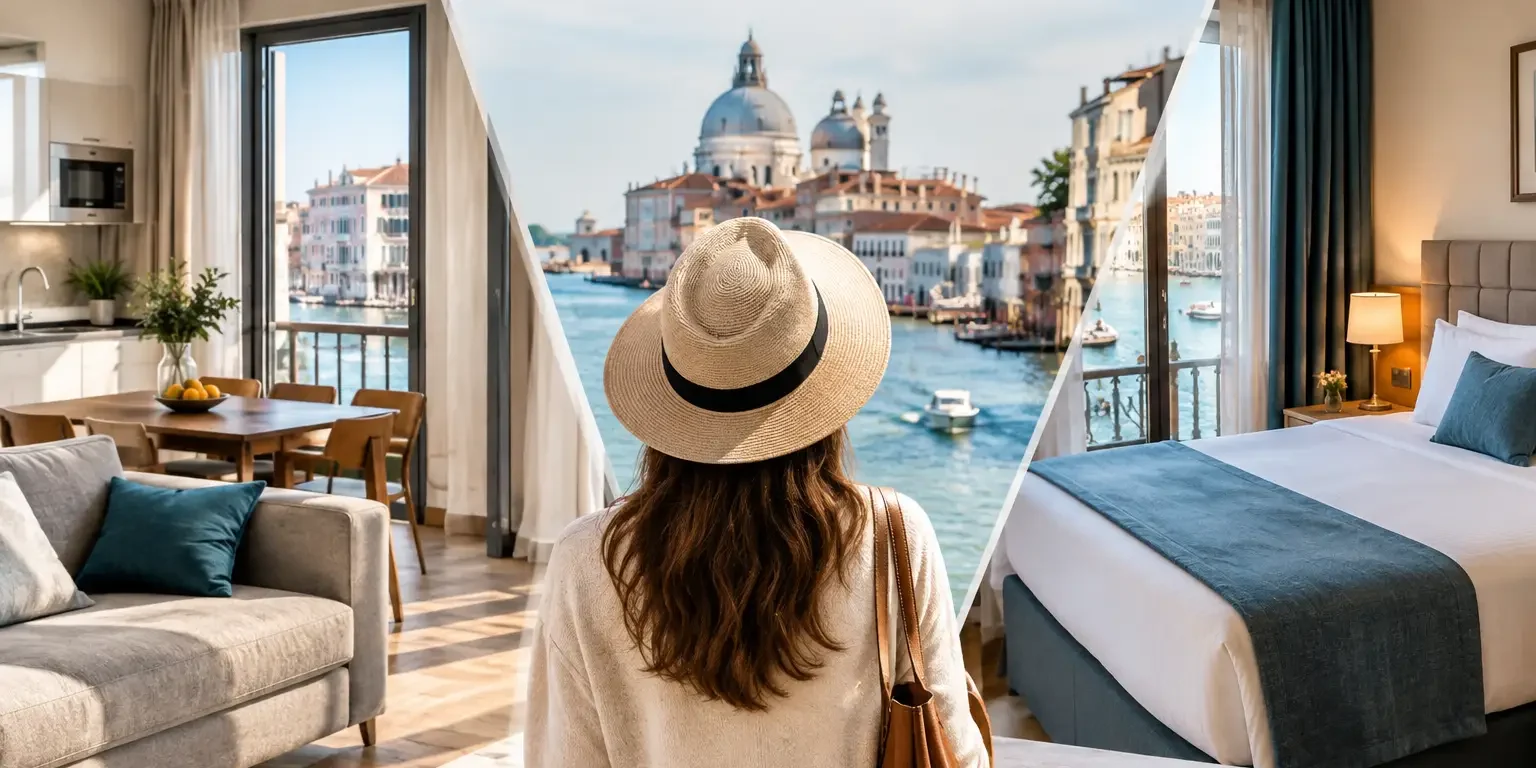
A Venice stay can be shaped as much by where you return at sunset as by what you see during the day. A thoughtful hotel apartment comparison helps clarify whether you want the familiar rhythm of a hotel or the greater privacy, space, and independence of an elegant residence – without giving up the care that makes a trip feel effortless.
For travelers drawn to the refined atmosphere of San Marco, the answer is rarely about one option being universally better. It is about choosing an address that suits the way you wish to experience the enchanted city: as a guest passing through, or with the ease and comfort of someone who has a beautiful place of their own.
Hotel or apartment: the real difference
A luxury hotel offers a distinct kind of reassurance. There is a reception desk, daily room service, public spaces designed for socializing, and often an extensive selection of facilities on site. For a short visit with a tightly planned itinerary, that clarity can be appealing. You leave in the morning, return in the evening, and the practical details are largely handled for you.
An apartment offers a more residential tempo. Instead of fitting life around a single room and hotel schedules, you have separate spaces to settle into. You can make coffee before the city wakes, pause for a quiet lunch after a museum visit, or enjoy an unhurried evening after the canals have grown still. In Venice, where the smallest calle can lead to an unexpected view or a neighborhood bar, this sense of belonging is especially meaningful.
The most compelling choice for many discerning visitors sits between these two models: a serviced luxury apartment. It preserves the independence of a private home while providing knowledgeable, responsive support when it is needed.
A hotel apartment comparison begins with space
Space changes the quality of time spent indoors. In a conventional hotel room, the bed, seating, luggage, and dining area frequently share one compact setting. This may be perfectly suitable when the room is simply a place to sleep. It can feel limiting, however, when you want to rest between appointments, unpack fully, or enjoy the city at a gentler pace.
A well-appointed apartment creates room for different moments of the day. A living area allows one person to read or work while another relaxes. A dining table turns a simple market purchase into a private meal. A fully equipped kitchen offers freedom rather than obligation: the option to prepare breakfast, chill a favorite bottle of wine, or keep refreshments close at hand.
This is not an argument for staying inside. Venice deserves to be explored on foot, by vaporetto, and from the water. Rather, more space means that returning home remains a pleasure. After hours among the mosaics of St. Mark’s Basilica, the art of the Accademia, or the lively streets around Rialto, a comfortable residence gives the day a gracious ending.
Service is not limited to a front desk
The common assumption is that hotels provide service while apartments provide independence. That distinction is too simple. The better question is what kind of service matters to you, and whether it is available with discretion and consistency.
A standard apartment rental can offer privacy but leave guests to manage arrival arrangements, local questions, maintenance concerns, and recommendations alone. At the other end, a large hotel can offer comprehensive support while making the stay feel more formal and less personal. A premium serviced apartment can bridge that gap through tailored assistance that respects both your time and your privacy.
In Venice, informed support carries particular value. The city has no cars at its center, and a journey that appears simple on a map can involve water transport, bridges, narrow passageways, and careful timing. Clear guidance on arrivals, parking options before entering the lagoon, transfers, tickets, and local experiences can remove uncertainty before it affects the trip.
The standard to look for is not constant interruption, but quiet availability. You should feel that help is close, recommendations are considered, and the practical details have been anticipated – while your apartment remains wholly your own.
Location means more than proximity
A central hotel and a central apartment may both be described as being near San Marco, yet the experience can be quite different. In a city built for walking, every location has its own daily rhythm. Some addresses place you in the center of activity but also in the center of noise. Others are close to the landmarks while offering a more composed return at the end of the day.
The Piano Nobile of a historic palazzo has a particular appeal in this respect. These noble-floor residences were designed for stature, proportion, and light, often with details that communicate Venice’s architectural heritage far more intimately than a standardized room can. When thoughtfully renovated, they can offer period character alongside the modern comforts international travelers reasonably expect.
At Ca’ Sant’Angelo, this balance is central to the experience: a historic Venetian setting near San Marco, paired with contemporary features such as high-speed Wi-Fi, satellite TV, a dishwasher, washing machine, and a fully equipped kitchen. The goal is not to recreate hotel life in an apartment. It is to make Venetian living feel polished, comfortable, and well supported.
Privacy and atmosphere: what kind of stay do you want?
Hotels have an energy of their own. Lobby encounters, breakfast rooms, concierge conversations, and the movement of guests can be part of the appeal. Travelers who enjoy a social atmosphere or prefer every element of their stay to be handled within one property may find that energy reassuring.
An apartment offers a quieter form of luxury. You are not waiting for an elevator with a tour group or arranging your day around breakfast hours. You enter through a residential doorway, close the door behind you, and return to a space that feels removed from the public rhythm of the city. For couples seeking privacy or travelers who value an unhurried schedule, that difference can be substantial.
There is also an emotional distinction. A hotel can make Venice feel like a destination viewed from the outside. A residence encourages a more personal connection: selecting pastries from a nearby bakery, recognizing the route home, and noticing how a familiar campo changes from morning to evening. These small rituals are often what remain in memory long after the major sights.
When a hotel may be the better choice
An apartment is not automatically the right answer. If you want a restaurant, bar, spa, gym, extensive meeting facilities, or round-the-clock staffed public areas under one roof, a full-service hotel may better meet your expectations. The same is true if you are making a very brief stop and place the highest value on the simplicity of a conventional check-in experience.
It also depends on your appetite for self-direction. Even the most carefully serviced apartment invites you to use the city more independently. That is part of its charm, but it suits travelers who appreciate a residence rather than those seeking an entirely programmed environment.
Still, choosing an apartment does not mean accepting compromises in quality. The strongest properties pair thoughtful interiors, reliable technology, immaculate upkeep, and attentive guest care with the freedom of a private address.
How to compare like for like
When assessing hotel and apartment options, look beyond the nightly rate. Ask how much usable living space is included, whether the kitchen is genuinely equipped, and whether laundry facilities are private and convenient. Consider the building’s character as well as its renovation standard, since beautiful photographs alone do not reveal noise levels, layout, or the quality of the materials around you.
Service should be evaluated with equal care. Find out how arrivals are managed, who can assist if plans change, and whether local guidance is specific to Venice rather than generic. Confirm the precise location and think about how you expect to use it: early walks to St. Mark’s Square, evenings at the theater, days spent visiting islands, or relaxed hours wandering the nearby streets.
Finally, consider the value of time. A private kitchen, washing machine, and welcoming living space may not be essential on paper, but they can make a longer stay feel noticeably more relaxed. Luxury is often less about excess than about having exactly what you need, exactly when you need it.
The best choice is the one that lets Venice feel less like an itinerary and more like a place you can inhabit beautifully, at your own pace.