

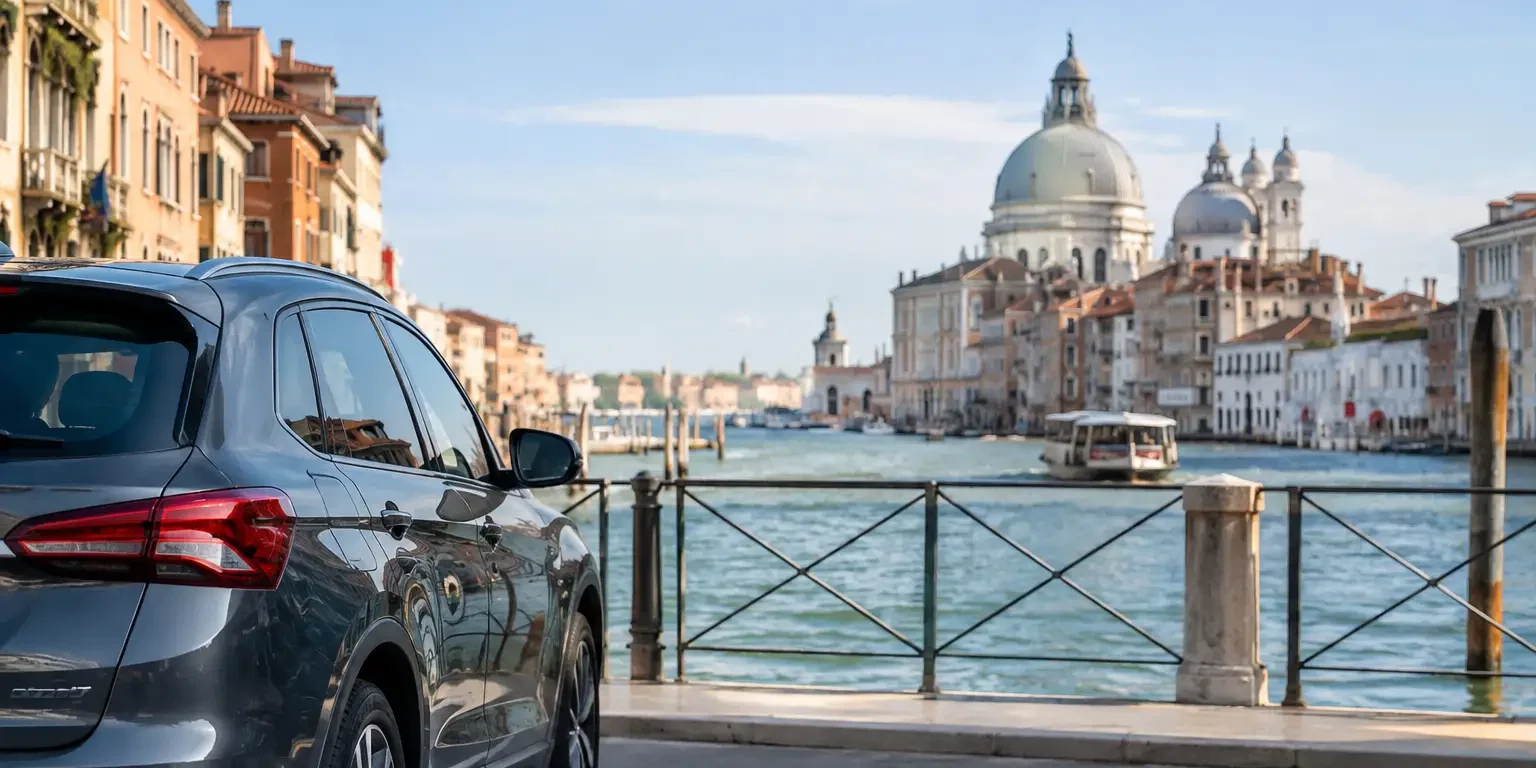
A car can bring you to the edge of Venice, but never through its heart. That distinction makes Venice parking one of the details worth arranging before departure, especially when your stay is centered around San Marco. With the right garage reserved and a clear plan for the final water transfer, arriving in the enchanted city can feel composed rather than complicated.
Venice parking begins at the water’s edge
Venice’s historic center is free of roads, cars, and ordinary street parking. Once you cross the long causeway from the mainland, private vehicles can go no farther than Piazzale Roma or Tronchetto. From there, Venice takes over in its own way: on foot, by vaporetto, or by private water taxi.
For most guests staying near San Marco, Piazzale Roma is the more convenient choice. It is the closest point accessible by car and has several covered parking garages. It also places you beside the waterbus stops and water-taxi piers, making it easier to continue toward the center with luggage.
Tronchetto, on an artificial island just before Piazzale Roma, can be an excellent alternative when its garages have more availability or a more appealing rate. It requires one extra step to reach the historic center, usually via the People Mover to Piazzale Roma, followed by a boat transfer. The difference is manageable, though after a long drive or with several bags, the simplicity of Piazzale Roma often justifies the choice.
Why reserving ahead changes the arrival
Parking capacity is limited, and demand rises sharply during weekends, holidays, Carnival, major exhibitions, and the height of summer. A confirmed reservation removes the uncertainty of circling for a space at the very moment you want to begin enjoying Venice.
When comparing garages, look beyond the daily rate. Confirm the opening hours, whether in-and-out access is permitted, the maximum vehicle height, and the cancellation terms. Larger SUVs, vans, roof boxes, and electric vehicles may have specific restrictions or charging arrangements. Save the garage address and booking confirmation offline before you travel, as mobile service can be inconsistent during the final approach.
Choosing between Piazzale Roma and Tronchetto
The best Venice parking option depends less on which garage is objectively best and more on how you wish to arrive.
Piazzale Roma is ideal when convenience is the priority. It shortens the distance between your car and the boat, and it is particularly well suited to travelers planning to take a private water taxi directly toward a central accommodation. A water taxi costs more than public transport, but it offers an unforgettable first view of the Grand Canal and avoids managing luggage across bridges.
Tronchetto suits travelers who are comfortable adding a short rail connection or walk to their onward journey. It can be a sensible choice for a longer stay, or when you prefer to leave the car securely parked and forget about it until departure. The time difference is not dramatic, but Venice rewards realistic timing. Allow extra time rather than scheduling a dinner reservation too tightly after your parking arrival.
For a stay near San Marco, public water transport from Piazzale Roma is practical and atmospheric, though it can be busy at peak hours. A private water taxi offers a more direct, tailored arrival. The ideal choice depends on your budget, the amount of luggage you have, your arrival time, and whether the journey itself is part of the experience you want to savor.
Do not follow your navigation blindly
The drive into Venice is straightforward until it suddenly is not. Navigation systems may suggest routes that are technically possible but poorly suited to visitor parking, particularly around restricted traffic areas on the mainland and the final approach to the garages.
Enter the precise address of your reserved garage, not simply “Venice center.” Follow road signage for Piazzale Roma or Tronchetto as you near the causeway. Avoid driving beyond designated parking entrances or stopping in unauthorized areas to unload. Restrictions are monitored, and a mistaken turn can be an expensive beginning to a vacation.
If you are collecting a rental car at the end of your trip, the same principle applies in reverse. Build in time for the water transfer, the walk through the garage, and any rental return procedures. Venice operates at a gentler pace than a typical city, but connections still have timetables.
A more economical option: park in Mestre
Mestre, on the mainland, is worth considering if you plan to use your car during a wider Italian itinerary or if central Venice garage availability is limited. Parking is generally more plentiful there, and rail or bus connections reach Venice in a relatively short time.
The trade-off is the arrival experience. Mestre makes sense for travelers who prioritize cost or need flexible access to their vehicle. Yet it adds a transfer before the Venetian part of the journey begins, which can be less appealing after an international flight or a long drive. For a short, special stay near San Marco, parking at Piazzale Roma or Tronchetto is usually the more comfortable decision.
Treat Mestre as a practical alternative, not a compromise to fear. With a well-timed train and light luggage, it can work very well. The key is choosing it deliberately rather than discovering it after central garages are full.
Make the final transfer feel effortless
The moment you leave the garage, switch your mindset from driving to Venice time. Keep essentials close at hand: identification, medications, valuables, a light jacket, and the address and arrival instructions for your accommodation. If you are taking public transport, have your tickets ready before boarding. If you have arranged a water taxi, confirm the meeting point and the name under which the booking was made.
Wheeled suitcases are useful, but the city’s bridges mean they are not effortless. Pack so that you can carry your bags briefly when needed, particularly if walking from a vaporetto stop. A water taxi can reduce those transitions considerably, although even its closest landing point may involve a short stroll through Venice’s narrow lanes.
At Ca’ Sant’Angelo, the reward for a well-planned arrival is stepping from Venice’s lively streets into the calm of a historic palazzo near San Marco. A little advance planning allows the first hours to belong to the city: a canal-side aperitivo, a quiet walk after sunset, and the pleasure of knowing your car is safely out of sight.
Before you set off
Check your garage reservation once more on the morning of travel, including its entry instructions and vehicle requirements. Plan for traffic on the causeway, especially on busy arrival days, and avoid treating an estimated driving time as a guarantee. Venice has no need for a rushed entrance.
Most importantly, do not plan to use your car during your stay in the historic center. Venice is experienced by water and on foot, one small campo and canal at a time. Leave the keys in the garage, travel lightly for the final leg, and let the city meet you on its own terms.