

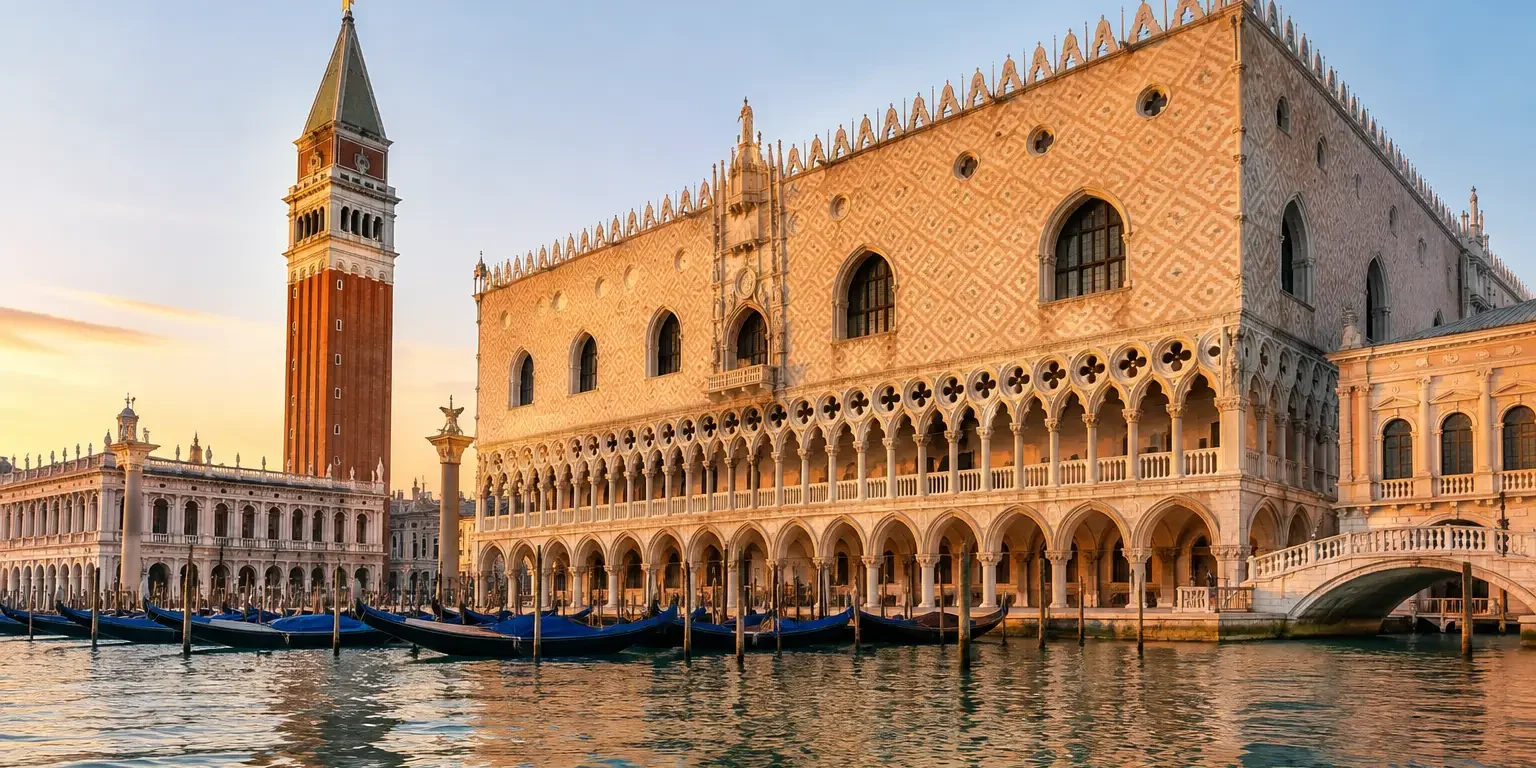
The Doge Palace history is written in stone, gilded ceilings, and the quiet corridors where Venice governed a maritime empire. Standing beside St. Mark’s Basilica, the palace is far more than one of the city’s most recognizable sights. For centuries, it was the working heart of the Venetian Republic: the doge’s residence, the meeting place of its councils, its courts, archives, and prisons.
A visit becomes especially rewarding when you see it not as a single beautiful building, but as a record of Venice’s ambitions, anxieties, and extraordinary political life. Its delicate Gothic arcades seem almost weightless against the lagoon, yet they supported one of Europe’s longest-lived republics.
From Fortress to Ducal Residence
The earliest Doge’s Palace stood on this site in the 10th century, although little remains of that first structure. It was conceived as a fortified residence, appropriate for a ruler whose position could be admired, challenged, or threatened by the city he governed. Venice was still developing its institutions and defending its commercial interests across the Adriatic and eastern Mediterranean.
A fire in 976 damaged the early palace during unrest against Doge Pietro IV Candiano. Subsequent rebuilding changed the character of the complex, but the palace continued to evolve rather than being replaced all at once. This is one reason its architecture feels so layered. Behind the celebrated exterior are traces of different eras, each responding to a new political need, fire, or artistic ambition.
By the 13th century, Venice had become a major commercial and naval power. The palace was no longer simply a residence for the doge. It needed to accommodate the increasingly sophisticated machinery of the Republic: elected councils, magistrates, clerks, ambassadors, and courts. The building’s expansion reflected a fundamental Venetian idea – power belonged not solely to one ruler, but to a carefully regulated network of institutions.
The Doge Palace History and the Republic’s Power
The palace seen today took much of its defining form in the 14th and 15th centuries. After the Great Council expanded following the Serrata, or “closing,” of 1297, a larger assembly hall was required. Construction began on the lagoon-facing wing in the 1340s, creating the vast Sala del Maggior Consiglio, where members of Venice’s ruling class gathered to vote and deliberate.
Its scale still carries meaning. This was not a throne room designed around a monarch’s private majesty. It was the chamber of a governing body, grand enough to express the Republic’s authority to foreign envoys and Venetian citizens alike. The doge presided, but his power was deliberately limited by councils and procedures intended to prevent one family or individual from dominating the state.
The palace’s airy lower arcades and ornate upper loggia are among the finest expressions of Venetian Gothic architecture. Their visual lightness is deliberate, although the engineering is substantial. Pale Istrian stone provides the framework, while the patterned pink Verona marble above gives the façade its distinctive warmth. The result is unusually Venetian: formal and ceremonial, yet responsive to the lagoon light that changes the building’s color throughout the day.
The western façade, facing the Piazzetta, was completed during the 15th century. Here, the Porta della Carta offered a richly carved ceremonial entrance linking the palace to St. Mark’s Basilica. It announced a close relationship between religious devotion and civic identity. Venice revered St. Mark as its patron, while presenting itself as a republic protected by divine favor and governed by human discipline.
Fire, Renewal, and Great Venetian Art
Fire repeatedly altered the palace. A blaze in 1483 destroyed parts of the doge’s private apartments and led to a Renaissance rebuilding along the canal side. Later fires in 1574 and 1577 were even more devastating, damaging important state rooms and works of art.
Venice chose restoration rather than reinvention. That decision preserved the palace’s Gothic exterior while allowing its interiors to become a magnificent showcase of late Renaissance painting. The restored chambers communicate the Republic’s confidence at a moment when its political and commercial dominance was beginning to face greater pressure from other European powers.
In the Sala del Maggior Consiglio, Tintoretto’s Paradise dominates one wall. Completed with assistance from his workshop after the 1577 fire, it is one of the largest oil paintings on canvas in the world. Its vast gathering of saints and angels is not simply decoration. It envelops the room in a vision of heavenly order, mirroring the earthly order Venice wished to project.
Elsewhere, works by Veronese, Tintoretto, Palma il Giovane, and their contemporaries fill ceilings and walls with allegories of justice, victory, wisdom, and the city’s special protection. These rooms were intended to impress. Diplomats waiting for an audience would have understood that Venice saw its prosperity and political system as inseparable from moral authority.
That message was polished, but it was not uncomplicated. The Republic could be remarkably stable and pragmatic, yet it also guarded its power closely. The palace contains lavish reception rooms alongside chambers used by the Council of Ten, Venice’s powerful security body. Beauty and surveillance existed under the same roof.
Courts, Secret Passages, and the Prisons
The palace’s darker side is part of its fascination. It housed courtrooms, offices of investigation, and detention cells. The Council of Ten, established in the 14th century after a conspiracy against the state, became especially associated with matters of security and political control. Its meetings took place in rooms whose restrained grandeur contrasts with the serious decisions made there.
The old prisons were located within the palace itself, including the notorious Piombi, cells beneath the lead-covered roof. They could be harshly hot in summer and cold in winter. Giacomo Casanova was held there in the 18th century before making his famous escape through the roof – an episode that has made the prison corridors legendary.
By the early 17th century, Venice had constructed the New Prisons across the canal. The Bridge of Sighs, completed around 1603, connected the palace’s interrogation rooms to those cells. Its romantic name came later, inspired by the imagined sighs of prisoners catching their final glimpse of Venice through its small stone windows. The bridge is undeniably evocative, but its original purpose was practical and severe.
The End of the Republic
The Venetian Republic ended in 1797, when Napoleon’s forces entered the city and the last doge, Ludovico Manin, abdicated. For more than a thousand years, Venice had maintained a distinct form of government. Its final years were marked by geopolitical pressure and a changing Europe in which the old republic could no longer preserve its independence.
The palace then served successive French and Austrian administrations before Venice became part of unified Italy in 1866. Its rooms lost their original governmental function, but their historic importance only became clearer with time. The building was eventually opened as a museum, allowing visitors to encounter the Republic through the spaces where it made decisions, displayed wealth, and administered justice.
How to Experience the Palace with Context
Allow more time than the façade suggests. The public route through the grand chambers can take a few hours when viewed attentively, particularly if you pause for the ceilings and the changing perspectives of the Scala dei Giganti, the courtyard, and the lagoon-facing windows. The Secret Itineraries route offers a different experience, taking visitors through institutional rooms and prison areas that reveal the working, less ceremonial side of government.
It depends on what you hope to take from the visit. Art lovers may want to linger in the Great Council Chamber and the Senate rooms. Travelers interested in political history will find the Council of Ten rooms and prisons especially compelling. A morning visit is often more peaceful, while late afternoon can be rewarding when the stone façades soften in the lagoon light.
For guests staying near San Marco, including at Ca’ Sant’Angelo, the palace is close enough to revisit at different times of day. See it first as a landmark, then return after a quiet walk through the surrounding calli. Venice is best understood gradually, and the Doge’s Palace rewards that kind of attention.
Leave the palace with one thought in mind: its splendor was never only personal luxury. Every gilded hall, guarded passage, and painted ceiling was part of Venice’s carefully composed image of itself – a city determined to make power look enduring, ordered, and unforgettable.