

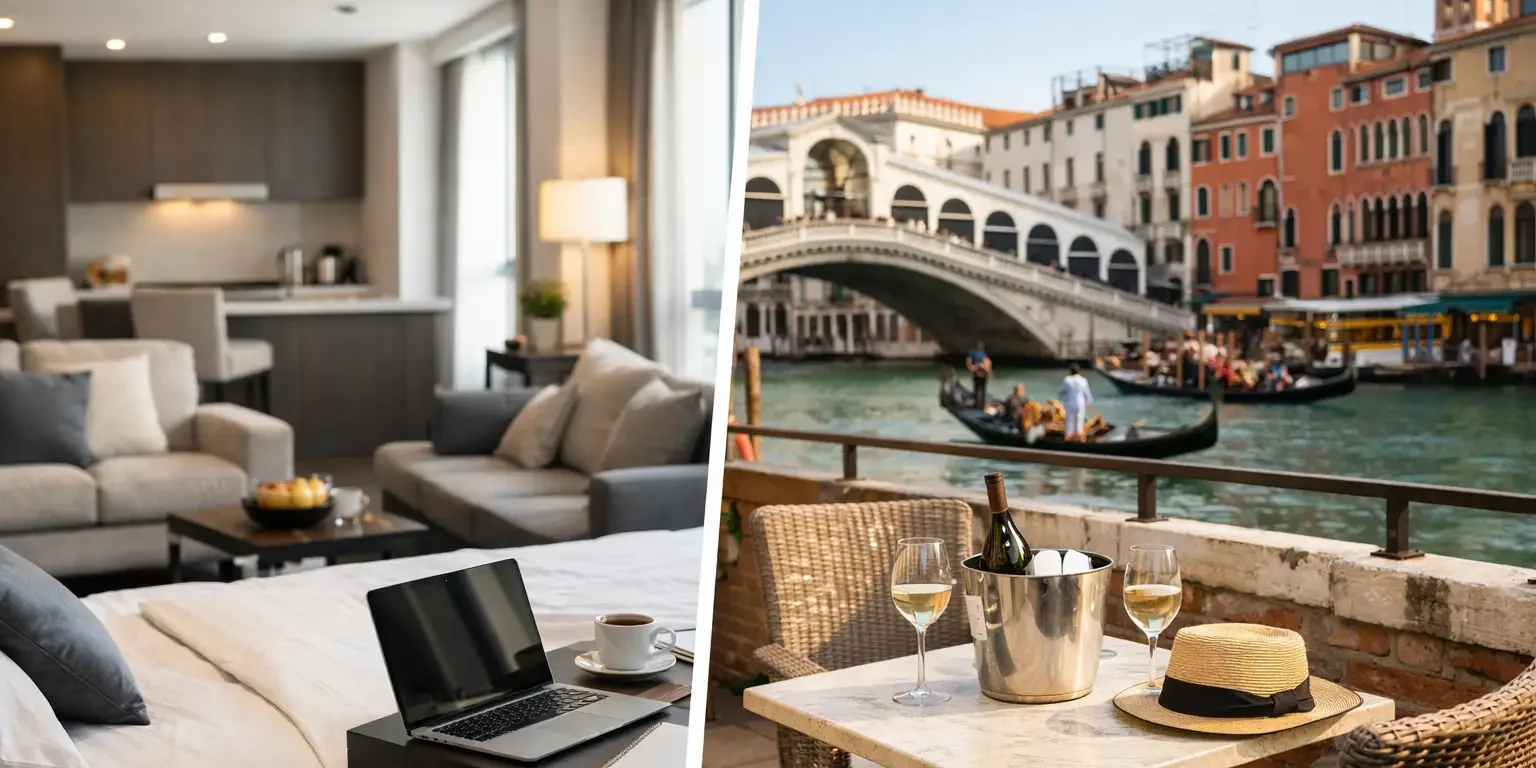
From a window on a quiet Venetian calle, the city can seem almost entirely made of water and stone: a narrow canal below, a small bridge beyond it, and the passing rhythm of boats instead of cars. That is why the question, how many canals and bridges are there in Venice?, has such appeal. The short answer is that Venice has roughly 177 canals and more than 400 bridges in its historic center. The fuller answer is more interesting, because the total depends on what, exactly, is included.
How many canals and bridges are there in Venice?
The figures most often used for Venice are 177 canals and approximately 400 to 435 bridges. You may also see a lower bridge count, often around 390, in guides that count only public pedestrian bridges within a particular administrative boundary.
The difference is not a mistake. Venice is a living city whose waterways, private crossings, footbridges, and island connections do not always fit neatly into one category. Some counts include small private bridges and bridges on neighboring islands; others focus solely on the six historic districts of Venice. For a visitor, the essential truth is simple: the city’s network is wonderfully dense, and every walk becomes a sequence of water views, stone crossings, and unexpected turns.
There are also more than 100 small islands in the Venetian Lagoon, although the number changes according to how islands, mudflats, and tidal land are defined. Venice is not one compact island surrounded by water. It is an intricate settlement built across a lagoon, connected by pathways that have evolved over centuries.
Venice’s canals are streets with water at their center
Venice’s canals are not decorative waterways added to a city. They are the original infrastructure of the city itself. Before Venice had paved walkways and elegant shopping streets, its channels were the most direct routes for people, provisions, building materials, and trade.
The Grand Canal is the best known of them all. It curves through the heart of Venice in a broad S-shape, lined with palaces that reveal the city’s commercial and noble past. Yet it is only one part of a much larger system. Smaller canals, often called rii, slip quietly between residential buildings and beneath modest bridges. These narrower channels are where Venice feels most private and residential.
A canal’s appearance can vary dramatically from one neighborhood to another. Near San Marco, you may find bustling waterways crossed by gondolas and water taxis. A few minutes away, the canals can become still enough to reflect shuttered windows, carved stone details, and the changing light of the day. This contrast is one of Venice’s great pleasures: major landmarks are close at hand, but the city continues to offer moments of remarkable calm.
Not every waterway visible on a map is counted as a canal in the same way. Some historic channels have been filled in and turned into streets, known as rio terà. Others are broad basins, docks, or lagoon passages rather than canals in the traditional urban sense. That is one reason a precise total can vary between references.
The Grand Canal and the quieter rii
For first-time visitors, the Grand Canal provides the most immediate introduction to Venetian life on water. Vaporetto routes trace its length, offering views of celebrated palazzi that cannot be appreciated fully from land. A private water taxi can feel especially memorable on arrival or departure, though it is a premium choice and not necessary for every journey.
The smaller rii provide a different experience. They are not designed for spectacle. Instead, they reveal the everyday geometry of Venice: deliveries by boat, laundry above the water, small landings at ground level, and doorways where a street in any other city would begin. A leisurely walk through these quieter areas is often more rewarding than trying to see every major sight in a single day.
Why Venice has so many bridges
Venice’s bridges make its pedestrian life possible. While boats move through the canals, people cross over them constantly, traveling between neighborhoods, shops, museums, churches, cafés, and homes. Most bridges are small, practical, and easy to overlook until one pauses to admire the view from the center.
The city’s larger bridges are landmarks in their own right. The Rialto Bridge is the most famous, crossing the Grand Canal near the historic market area. The Accademia Bridge offers one of the finest broad views along the Grand Canal. The Scalzi Bridge stands near Santa Lucia train station, while the Constitution Bridge links the station area with Piazzale Roma.
These celebrated crossings are only a fraction of Venice’s bridge landscape. Much of the magic lies in the anonymous bridges: a gently arched span over a quiet canal, a narrow crossing that opens onto a tiny campo, or a bridge where the route seems to split in several directions at once.
Bridge counts vary partly because Venice has bridges of different kinds. Many are public pedestrian bridges, while others lead to private homes, courtyards, gardens, or institutional buildings. A count may include bridges on the islands of Giudecca, Murano, Burano, and other lagoon communities, or it may exclude them. There are also newer structures and restorations, which can affect a total over time.
A note on accessibility and walking
Venice is exceptionally walkable, but its bridges are also the city’s principal challenge for travelers with limited mobility or heavy luggage. Many have steps, and even routes that appear direct on a map may involve several crossings. If comfort and ease matter, it is wise to choose accommodations in a central location and plan arrivals carefully.
For guests staying close to San Marco, much of Venice’s most compelling cultural life can be reached on foot. At Ca’ Sant’Angelo, the advantage is not simply proximity to famous places. It is the freedom to return between outings, settle into a private apartment, and let the city unfold at a more gracious pace.
Water buses are useful when distances feel longer than expected, especially for reaching the train station, Piazzale Roma, or lagoon islands. They are practical rather than private, and can be busy at peak times. Walking remains the best way to understand Venice’s scale, provided you allow extra time and welcome the occasional wrong turn.
What the numbers reveal about Venice
The number of canals and bridges is impressive, but the statistics matter less than what they represent. Venice developed a transportation system around water because the lagoon offered protection, trade access, and a foundation for settlement. Its architecture adapted accordingly, with buildings facing canals as naturally as city buildings elsewhere face avenues.
This is why Venice rewards unhurried travel. A bridge is rarely just a bridge. It may frame a glimpse of a bell tower, lead into an almost empty square, or mark the transition from a lively commercial route to a residential corner. A canal is rarely just a route for boats. It is a visual axis, a working waterway, and a reminder that the city has always moved to its own rhythm.
Visitors sometimes expect Venice to be difficult to navigate because there are no cars. In practice, the city becomes easier once you stop treating every turn as a problem to solve. Follow the signs when you need to reach a landmark, but leave room for detours. The most memorable Venice is often found between destinations, on the bridge you did not intend to cross or beside the canal you had not planned to see.
Making the most of Venice’s waterways
A balanced day in Venice might begin early, when the canals are quiet and the light is soft on the facades. Walk before the busiest hours, perhaps through San Marco toward Castello or across the Rialto area before the crowds build. Later, take a vaporetto along the Grand Canal for the perspective that walking cannot provide.
A gondola ride offers a more intimate view of the smaller canals, though the experience is best chosen for atmosphere rather than transportation. For many travelers, one carefully timed ride near sunset is more meaningful than trying to fit in every classic activity. If you prefer a quieter scene, wander beyond the main routes and pause at a waterside table or a small campo as evening approaches.
Venice’s canals and bridges cannot be fully understood through a single number. They are the framework of an enchanted city that asks you to slow down, look upward at the palaces, downward at the water, and occasionally take the bridge that leads somewhere unknown.