

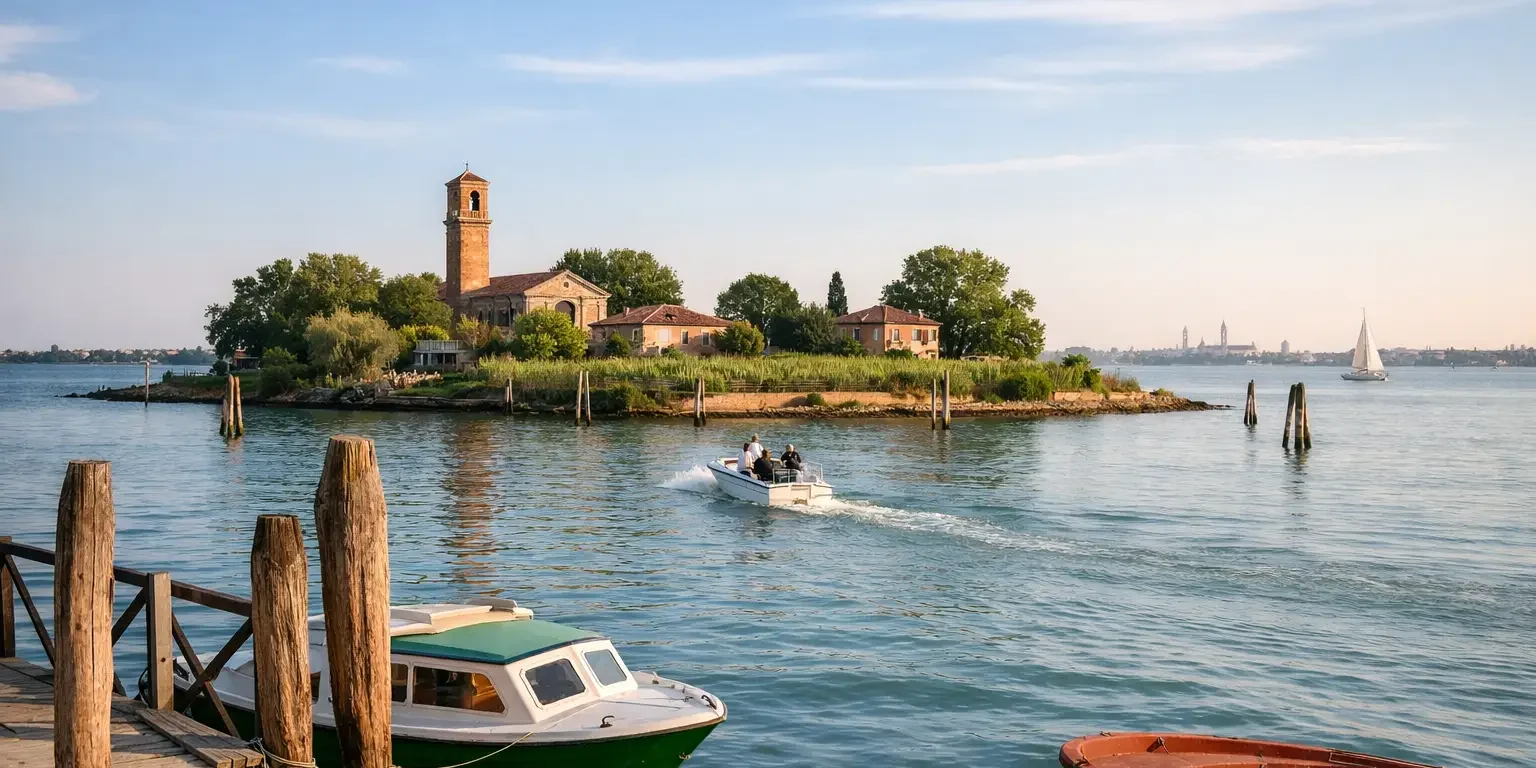
A Venetian morning often begins with the familiar choreography of San Marco: footsteps on polished stone, coffee cups arriving at small tables, boats cutting across the basin. Then there are the unknown islands of Venice: Vignole, where that choreography falls away. Just beyond the city’s celebrated waterfront, this low-lying pair of islands offers cultivated land, broad lagoon skies, and a pace that feels distinctly removed from the center.
Vignole is not an island for checking off major sights. It is a place to visit for the pleasure of having fewer plans: a walk beside water, the scent of vegetation after rain, and views that reveal Venice as a lagoon city rather than a collection of famous facades. For travelers who appreciate the city’s quieter dimensions, it makes a graceful half-day diversion.
Why Vignole Feels So Different From Central Venice
The name Vignole is linked to vines, and agriculture remains central to the island’s identity. While much of Venice is shaped by narrow calli, marble churches, and dense urban life, Vignole has open ground, gardens, and a rural character that can be surprising so close to the historic center.
The island is made up of two closely connected areas, sometimes called Vignole Grande and Vignole Piccola. Its atmosphere is uncomplicated and residential rather than curated for visitors. There are no grand museum interiors or rows of souvenir shops to direct the afternoon. That is precisely its appeal.
Here, the lagoon is not simply a view from a hotel terrace or a backdrop for a photograph. It is the defining presence. Looking across the water, visitors can better understand the geography that made Venice possible: a city suspended among channels, defensive outposts, working islands, and cultivated land.
Vignole is especially rewarding for guests who have already given time to the essential landmarks and would like to see another register of Venetian life. It replaces spectacle with perspective.
Reaching Vignole With Ease
A visit requires a vaporetto journey, and the route is part of the experience. Water transport schedules and stops can change by season, day, or service pattern, so it is wise to confirm the current ACTV timetable before setting out. Allow more time than the map might suggest. In Venice, travel is often measured not in distance but in the rhythm of boats, boarding points, and the weather over the lagoon.
From a central base near San Marco, such as Ca’ Sant’Angelo, it is simple to begin the day with the city at hand and reserve Vignole for a slower afternoon. Leave after a relaxed lunch, or go early when the light is clear and the island is at its calmest. The journey offers shifting views toward Castello, Sant’Erasmo, Murano, and the outer lagoon.
Bring water, sun protection in warmer months, and shoes suited to uneven paths. Vignole is not a formal garden promenade, and that lack of polish is part of its character. Facilities and dining options are limited compared with Venice proper, so it is best not to arrive expecting the convenience of the city center.
A Note on Timing
Spring and early fall are particularly pleasant, when the island’s cultivated landscape feels most vivid and temperatures encourage unhurried walking. Summer can be beautiful but exposed, with little relief from the sun along open stretches. In winter, Vignole has a more austere beauty: silvery water, bare branches, and an almost meditative stillness. It depends on what you seek. For color and softness, choose spring. For solitude and atmosphere, a crisp winter day can be memorable.
What to Notice on Vignole
The best way to experience Vignole is to keep your attention broad. Notice the transition as the city recedes, the gardens and small-scale dwellings, and the changing color of the water. This is a place where the details are modest but revealing.
Its agricultural past is not a decorative story added for visitors. The lagoon islands have long helped supply Venice with produce, and neighboring Sant’Erasmo remains particularly associated with market gardens. Vignole belongs to this wider landscape of cultivation, one that sustained the Republic as surely as its maritime trade did.
The island also sits near waterways shaped by Venice’s historic defenses. The imposing Fort of Sant’Andrea, on a nearby island at the entrance to the lagoon, is a reminder that these quiet waters were once closely guarded. From this part of the lagoon, Venice feels less like an isolated masterpiece and more like a strategic, living territory.
Do not rush to turn every view into a photograph. Some of Vignole’s most rewarding moments are nearly empty of action: a moored boat moving gently with the tide, a bird crossing the reeds, a distant bell carried over water. The island asks for a different kind of attention than the Basilica of St. Mark’s. Give it that attention, and it becomes richly expressive.
Pairing Vignole With a Wider Lagoon Day
Vignole works well as one element of a thoughtfully planned lagoon itinerary. Its location makes it possible to combine the visit with Sant’Erasmo, where the agricultural character becomes even more apparent, or with Murano if you would like to balance quiet landscapes with workshops and historic glassmaking.
There is a trade-off. Trying to visit several islands in one day can turn a peaceful outing into a timetable exercise. If Vignole is the reason for leaving central Venice, let it remain the center of the excursion. One nearby stop is usually enough, particularly if your goal is to return to San Marco in time for an aperitivo or an evening walk.
For guests interested in Venice’s fortified edges, the surrounding waters offer a compelling perspective even without entering every site. For those drawn to food and local produce, pairing Vignole with Sant’Erasmo can be more satisfying. Choose according to your interests, rather than following a fixed island-hopping formula.
A More Considered Way to Visit
Vignole is a residential and working environment, not an open-air attraction. Keep voices low near homes, stay on appropriate paths, and carry away anything you bring. The same consideration that makes a private palazzo stay feel special also matters here: Venice reveals itself most generously when visitors treat it as a place where people live, work, and maintain fragile surroundings.
It is also worth accepting that an island visit may be shaped by conditions beyond your control. High water, wind, heat, seasonal closures, and changes to boat service can alter the day. Rather than treating that as an inconvenience, leave room in the itinerary for adjustment. In Venice, flexibility often leads to the more authentic experience.
A visit to Vignole will not replace the great ceremonies of Venice – the glow of the Grand Canal at dusk, the art of the Accademia, or the first sight of St. Mark’s Square. It offers something more private: a pause in which the enchanted city becomes quieter, wider, and unexpectedly close to the land that surrounds it.
Return to the center before evening, perhaps with time to rest before dinner, and you may find that the familiar palaces and canals look subtly different. After Vignole, Venice is no longer only a city on the water. It is a city made possible by the lagoon.